1922-23 FA Cup · The Final
1923 FA Cup Final: Bolton Wanderers 2-0 West Ham United
The White Horse Final
Parliament debated this final before the bruises had faded, and what the House was told does not match the story everyone repeats.
Bolton beat West Ham on the day Wembley opened, in front of a crowd nobody could count, on a pitch the police had to clear twice.
Saturday 28 April 1923 · Empire Stadium, Wembley
What you will not find elsewhere
The white horse reached the House of Commons within 48 hours
On Monday 30 April 1923, two days after the match, the Commons turned to the crowd at Wembley. Amid what the House called almost universal praise for the police, one member singled out the officer who was mounted on a white horse. The Home Secretary replied: "Yes, Sir; I am delighted at it." The legend was in the official parliamentary record before the following weekend, and it is recorded there as a white horse, not a grey one.[7]
Twelve detained in hospital, not the figure usually quoted
Modern accounts, including the one this page drew on, put the number taken to hospital at about 22. From the despatch box on 30 April the Home Secretary told the House he was informed that 12 persons were detained at hospital, several already discharged, with serious cases numbering six or seven. Both can be true: Hansard is Monday's first report and the Shortt inquiry counted later. We show the tension rather than picking the tidier number.[7][8]
An official crowd estimate, given to Parliament two days later
Asked about access to the exhibition grounds, Lieut.-Colonel Buckley told the House the crowd at Wembley was estimated at not less than 200,000 persons, and that the rapidity with which the assemblage was poured into the area caused the trouble. That figure sits between the 126,047 counted through the turnstiles and the police estimate of just under 300,000.[7]
How big was Wembley in 1923? Even the official sources disagree
Wembley Stadium's own site gives the Empire Stadium's designed capacity as 127,000, while The FA's cup histories and several contemporary-rooted accounts say 125,000. The turnstile count of 126,047 who paid to get in sits between the two claims, which may be why both figures survive in otherwise reliable places. Where this page needs a single design figure in prose it says roughly 125,000, the value contemporary reporting used.[12][17][11][5]
The footage
The match report
The first FA Cup final at Wembley was very nearly not played at all. The Empire Stadium, built for the following year's British Empire Exhibition, was barely finished, and tickets were sold at the turnstiles on the day as was then normal. Nobody planning the afternoon had grasped what a first Wembley final, a fine spring Saturday and open admission would draw. Gates opened at 11:30am and were closed by 1:45pm with the ground already beyond its designed capacity of around 125,000. At 2:15pm the crowd outside pushed through the barriers, and within minutes a vast, good-humoured and entirely uncontrollable mass of people was standing on the pitch.[12][15][10]
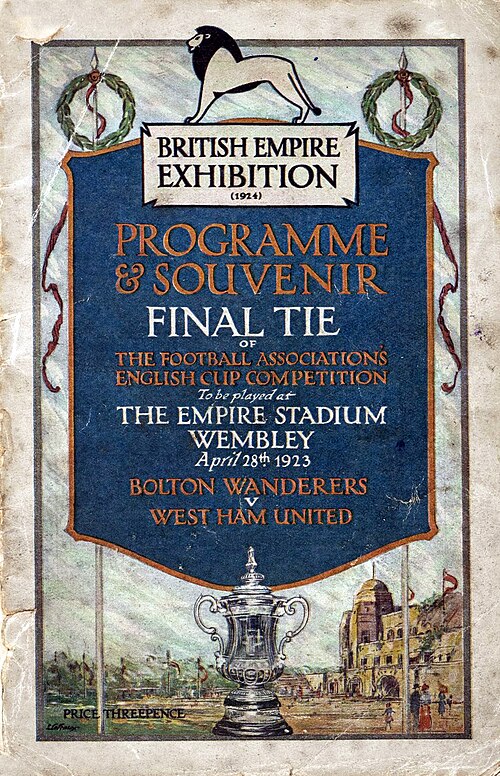
Clearing them fell to a handful of officers on foot and around ten mounted police, among them PC George Scorey on a seven-year-old grey named Billy. Newsreel cameras filmed them in high contrast, which rendered the grey horse almost white against the dark crowd, and gave the afternoon its name. King George V arrived at 2:45pm to find the pitch still full. The bands struck up the national anthem, the crowd began cooperating with the police, and play finally started at around 3:10pm, some 45 minutes late, on a surface already cut up by thousands of feet and hooves.[10][12][4]
Bolton scored inside two minutes, and the goal was pure product of the chaos. West Ham's Jack Tresadern was taking a throw-in and found himself swallowed by the crowd on the touchline, unable to get back onto the field. David Jack collected the loose ball and drove it past Ted Hufton so hard that it struck a spectator pressed against the netting behind the goal and knocked him unconscious. West Ham replied almost immediately, Vic Watson shooting over the bar from a promising position on three minutes.[1][15][2]

On eleven minutes the crowd surged again and the referee suspended play while mounted police pushed the touchlines back and first aid was given to spectators who had been crushed. When it resumed, West Ham had the better of a long spell. Dick Richards beat two defenders and shot; Dick Pym fumbled it and scrambled the ball clear before it crossed the line. Pym then parried a Jimmy Ruffell free-kick and saved the rebound from Watson. Bolton had a Jack Smith effort ruled out for offside on forty minutes, and at the interval the players simply stayed on the pitch for five minutes, because they could not get through the crowd to the dressing rooms.[1][18]
West Ham started the second half the stronger, and Watson mis-hit another good chance. Bolton's response was tactical: when West Ham came forward they dropped into a shape with five half-backs, and their goal was not seriously threatened again. The match was settled eight minutes after the restart. Ted Vizard worked the ball infield and Jack Smith struck it goalwards. West Ham insisted it had rebounded from the post without crossing the line, and complained separately that a Bolton supporter in the crowd had helped the ball on to Vizard. Referee Asson overruled them, ruling that the ball had gone in and bounced back out off a spectator standing behind the goal.[1][12][2]
The conditions shaped the football throughout. With spectators ringed around the touchlines, every throw-in in the match was taken from inside the field of play. If the ball struck the crowd and came back, play simply continued; it stopped only when the ball went over their heads. Late on, West Ham's captain George Kay tried to persuade the referee to abandon the match. Bolton's captain Joe Smith is said to have answered that his side were doing fine and would play until dark if that was what it took to finish it.[1]
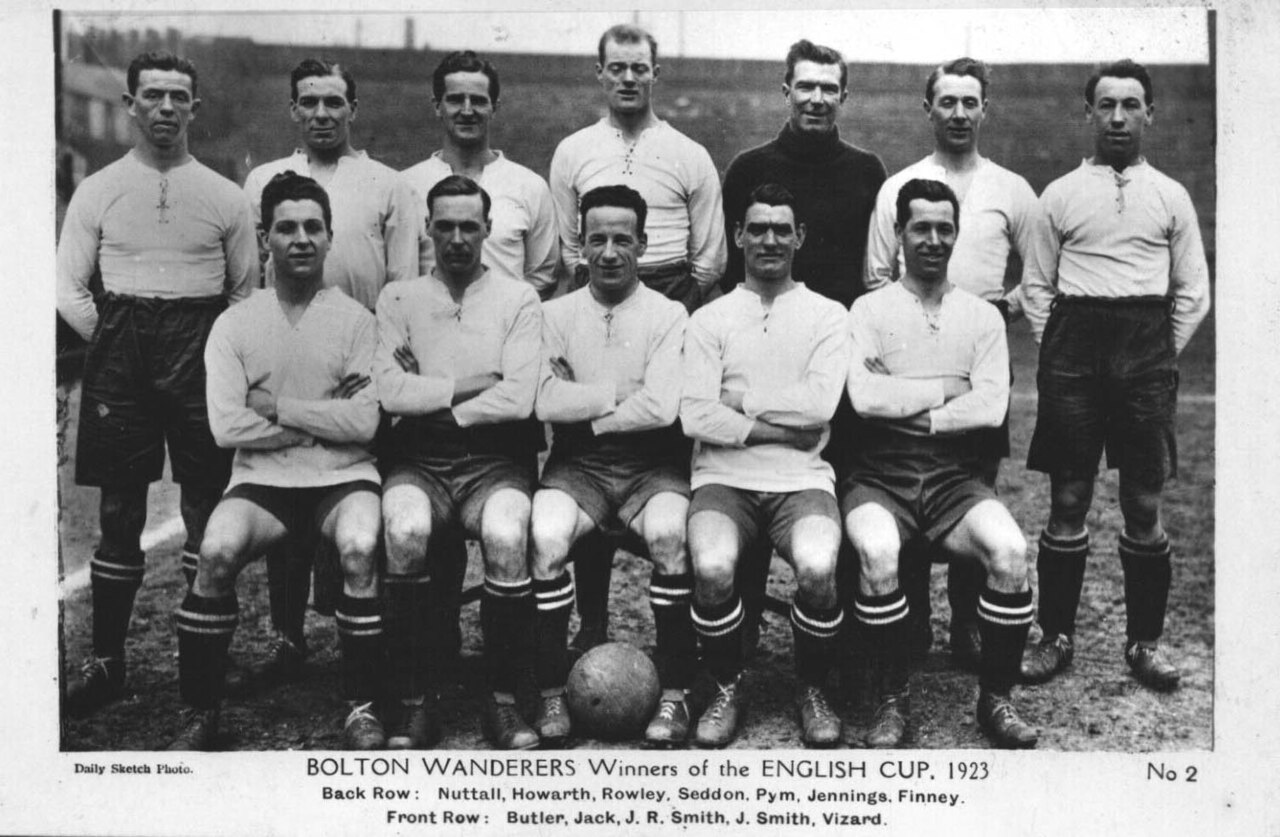
It ended 2-0. The King presented the trophy to Joe Smith and left to cheers, and both teams were given gold commemorative medals. Remarkably, given the scale of the crush, nobody died: around 900 to 1,000 people were treated for minor injuries, about 22 went to hospital, and two police officers were hurt. The official gate was 126,047, though estimates of how many were actually inside run from 150,000 to a police figure of just under 300,000. The FA refunded ten per cent of gross receipts of just over 27,000 pounds to ticket holders who never reached their places.[7][8][12][1]
The consequences outlived the match. A government committee under Sir Edward Shortt was convened within weeks, and its recommendations pushed the FA into a policy it had previously resisted: cup final tickets would from then on be sold in advance rather than at the turnstile. Wembley gained more turnstiles, extra gates and railings, and terraces divided into separately accessed sections. For Bolton it was a first FA Cup. For English football it was the afternoon that changed how crowds at showpiece matches were managed.[6][8][2][1]
How the match unfolded
- 11:30Gates open for a 3pm kick-off.[15]
- 13:45Gates are closed with the ground already beyond capacity.[15]
- 14:15Barriers are rushed and spectators flood onto the pitch.[4][12]
- 14:45King George V arrives. The bands play the national anthem and the crowd begins helping to clear the playing area.[12][18]
- 15:10Play finally begins, roughly 45 minutes late.[12][18]
- 2'David Jack scores. Jack Tresadern is entangled in the crowd while taking a throw-in; the shot beats Ted Hufton and strikes a spectator pressed against the net, knocking him unconscious.[1][15][2]
- 3'Vic Watson shoots over the crossbar from close range at the other end.[1]
- 11'The crowd surges forward again and play is suspended while mounted police clear the touchlines. First aid is given to unconscious spectators.[1]
- 40'Jack Smith puts the ball in the net but the goal is disallowed for offside.[1]
- half-timeThe players stay on the pitch for five minutes, unable to reach the dressing rooms through the crowd.[18][17]
- 53'Ted Vizard plays the ball inside and Jack Smith scores Bolton's second, over West Ham protests that it rebounded from the post.[12][2]
- full-timeBolton win 2-0. The King presents the trophy to Joe Smith; both teams receive gold commemorative medals.[2][18][1]
Match facts
- Date
- Saturday 28 April 1923
- Venue
- Empire Stadium, Wembley, London
- Attendance
- 126,047126047 is the official turnstile figure and the only number anyone agrees on. Estimates of how many actually got inside range from about 150000 to a police figure of just under 300000.[2][10][14]
- Half-time
- 1-0
- Competition
- 1922-23 FA Cup
Where they played
Both sides as they lined up. Choose any player to read what they did in this final.
Select a shirt for that player's note.
Route to the final
Bolton Wanderers
- Round 1: Norwich City (a) won 2-0
- Round 2: Leeds United (h) won 3-1
- Round 3: Huddersfield Town (a) drew 1-1, replay (h) won 1-0
- Round 4: Charlton Athletic (a) won 1-0
- Semi-final: Sheffield United (Old Trafford) won 1-0
West Ham United
- Round 1: Hull City (a) won 3-2
- Round 2: Brighton and Hove Albion (a) drew 1-1, replay (h) won 1-0
- Round 3: Plymouth Argyle (h) won 2-0
- Round 4: Southampton (a) drew 1-1, replay (h) drew 1-1, second replay (Villa Park) won 1-0
- Semi-final: Derby County (Stamford Bridge) won 5-2
Line-ups
Bolton Wanderers · 2-3-5
- Dick Pym Goalkeeper
- Bob Haworth Right back
- Alex Finney Left back
- Harry Nuttall Right half
- Jimmy Seddon Centre half
- Billy Jennings Left half
- Billy Butler Outside right
- David Jack Inside right, scored the first goal at Wembley
- Jack Smith Centre forward, scored the disputed second
- Joe Smith Inside left, captain
- Ted Vizard Outside left
West Ham United · 2-3-5
- Ted Hufton Goalkeeper
- Billy Henderson Right back
- Jack Young Left back
- Sid Bishop Right half
- George Kay Centre half, captain
- Jack Tresadern Left half
- Dick Richards Outside right
- Billy Brown Inside right
- Vic Watson Centre forward
- Billy Moore Inside left
- Jimmy Ruffell Outside left
Trivia and detail
- PC George Scorey was a First World War veteran and former army trumpeter who had served in the Boer War, and joined the Metropolitan Police mounted branch in 1919 despite being below the force's normal minimum height.[3]
- The FA offered Scorey free tickets to future finals as thanks. He had little interest in football and by most accounts never used them.[15][1]
- When Billy died in December 1930, Scorey was presented with a silver-mounted inkwell made from one of the horse's hooves, now held at the Metropolitan Police mounted branch museum at Imber Court.[15]
- West Ham reached the final without playing a single top-flight team, every opponent coming from the Second Division or lower.[13][5]
- David Jack scored the only goal in every one of Bolton's matches from the third round onward on the way to the final.[1]
- The events were debated in the House of Commons within days. The Home Secretary praised both the police and the crowd for their restraint, and a young Oswald Mosley was rebuked by the Speaker for calling the attendees hooligans.[7][9][1]
- When the new Wembley Stadium opened in 2007, one of its approach bridges was named White Horse Bridge following a public vote.[15][18]
How well do you know the 1923 final?
Five questions. Every answer is sourced from the material on this page.
-
Who scored Bolton's opening goal, inside the first two minutes?
-
What is the official turnstile attendance for the first Wembley final?
-
What was the name of the horse in the famous photographs?
-
What was unusual about West Ham's route to this final?
-
Where was the crush at the final formally debated within days?
Answer
The House of Commons. The Home Secretary answered questions on it, and the exchange survives verbatim in Hansard.[7]
What is not settled
Honesty matters more than tidiness. These details are contested or unrecorded, and we have not guessed at them:
- Hansard and modern secondary accounts disagree on how many people were taken to hospital: 12 detained according to the Home Secretary on 30 April 1923, about 22 in later accounts.
- The true attendance is genuinely unresolved. Only the official turnstile figure of 126047 is a hard number; estimates of the crowd actually inside range from about 150000 to a police figure of just under 300000.
- The exact length of the kick-off delay is reported inconsistently, from about 40 to about 45 minutes. No source gives a precise sourced figure.
- One low-quality secondary source names a 'Walter Rowley' in the Bolton XI. No other source consulted includes him, so he is treated as a scraping artifact and omitted.
- One scraped source lists the second scorer as 'Joe Smith' rather than Jack Smith. This appears to be a conflation of Bolton's two different Smiths, the captain Joe and the goalscorer Jack.
- A claim that referee Asson's father was a well known Swiss referee is flagged as unverified by Wikipedia itself, so it is omitted here entirely.
- Contemporary sources give the second scorer as both Jack Smith and John Smith. Jack is a diminutive of John and they are the same player, distinct from Bolton's captain Joe Smith.
- Gate times vary by account: the Bolton News retrospective has the gates opening at 11am, other accounts say 11:30. All agree the gates were closed by 1:45pm with the ground already beyond capacity.
- The Empire Stadium's designed capacity is given as 125000 by The FA's cup histories and 127000 by Wembley Stadium's own site. Contemporary reporting used roughly 125000.
How we know
Every claim on this page is tied to a numbered source below. These are the contemporary records behind it, each one fetched and matched word for word before publication rather than taken on trust:
- HC Deb 30 April 1923 vol 163 cc970-3 · Hansard, House of Commons
- HC Deb 02 May 1923 vol 163 cc1380-2 · Hansard, House of Commons
- HC Deb 10 May 1923 vol 163 cc2559-61 · Hansard, House of Commons
Where a primary record and a modern account disagree, we show both rather than choosing the tidier number.
Sources
- 1923 FA Cup final · Wikipedia
- 1923 FA Cup Final: 100 Years On · Bolton Wanderers FC
- George Scorey · Wikipedia
- Wembley Fa Cup (1923), FILM ID 304.11 (archive film and catalogue synopsis) · British Pathe (official YouTube catalogue)
- 1923 Cup Final · Spartacus Educational
- The Shortt Report · footballsafety.com
- Football Cup-Tie (Wembley Stadium), HC Deb 30 April 1923 vol 163 cc970-3 · Hansard, House of Commons
- Appointment of Committee, HC Deb 02 May 1923 vol 163 cc1380-2 · Hansard, House of Commons
- Wembley Stadium (Football Cup-Tie), HC Deb 10 May 1923 vol 163 cc2559-61 · Hansard, House of Commons
- The history of the FA Cup · The Football Association
- Five of the best FA Cup finals · The Football Association
- The first ever match at Wembley · Wembley Stadium (official site)
- Club history: the 1920s · West Ham United FC
- West Ham United 0 Bolton Wanderers 2, 28 April 1923 (match record) · westhamstats.info
- Bolton Wanderers v West Ham United: story of the White Horse FA Cup final · The Bolton News
- Looking back: 1923 White Horse cup final · The Bolton News
- FA Cup Finals 1920-1929 · Historical Football Kits
- 100 years: the Empire Stadium, Wembley, is opened to the public for the first time · British Online Archives