Neil Robertson
Playing Style
Neil Robertson's cue action — smooth, effortless, generating maximum power from minimum apparent effort — is among the finest in the game. A left-hander who made the extraordinary commitment of relocating from Melbourne to Britain in order to pursue his career on the professional tour, his break-building is methodical and prolific. He approaches the game with a scientist's rigour: he is meticulous in his preparation, analytical in his shot selection, and consistent in his execution to a degree that has allowed him to accumulate more than 900 career centuries from a player who only turned professional in 1999.
Robertson made the extraordinary commitment of relocating from Melbourne to Britain in order to pursue his career on the professional tour.
Robertson's potting is exceptionally accurate from distance, and his positional play reflects years of careful analytical preparation. He can play at high pace when the situation demands — his 2009 Masters performance remains one of the most dominant displays ever seen at Alexandra Palace — but he can equally adopt a more measured, tactical approach when the game calls for it. His flexibility, both technically and strategically, is one of the qualities that has kept him at the summit of the sport for so long. Unlike some of the game's great players who have one dominant mode, Robertson can adjust to the conditions of any match.
Career Biography
Neil Robertson was born in Melbourne, Australia, on 11 April 1982. He grew up in a country where snooker, while played, has never had the cultural resonance it carries in Britain, and his decision to move to the UK in pursuit of a professional career represented a significant personal commitment that speaks to his determination and ambition. He turned professional in 1999 at the age of 17, and the early years on the tour were a period of acclimatisation — learning the circuit, building his game, and gradually establishing himself as a consistent presence in the world's top 32 and then top 16.
Robertson left Melbourne as a teenager to pursue his snooker dream in the UK. His 2010 World Championship win made him only the third non-British, non-Irish player to lift the trophy in the modern era.
Robertson's first major breakthrough came with his 2009 Masters title at Alexandra Palace, a tournament regarded by many in the sport as second only to the World Championship in prestige. His performance that week was extraordinary — he played with a freedom and confidence that suggested a player whose moment had arrived. Then, in 2010, came the World Championship. Robertson navigated the draw at the Crucible with authority, reaching the final where he defeated Graeme Dott 18-13. The victory made Robertson the first overseas player to win the world title since Peter Ebdon in 2002, and only the third non-British, non-Irish player to do so in the modern era. It was a landmark achievement for Australian snooker and for Robertson personally.
Robertson left Melbourne as a teenager to pursue his snooker dream in the UK. His 2010 World Championship win made him only the third non-British, non-Irish player to lift the trophy in the modern era.
The years that followed 2010 cemented Robertson's status as one of the sport's pillars. He won the UK Championship in 2012 and 2014, adding to his collection of Triple Crown titles and completing the set alongside his Masters and World Championship wins. His ranking event victories accumulated at a steady rate throughout the 2010s, and he spent extended periods at or near the world number one position. In 2014 alone, he was the most prolific ranking event winner on the tour. His rivalry with Mark Selby, Judd Trump, and Ronnie O'Sullivan defined the mid-2010s era of snooker, and his contributions to some of the finest matches of that period placed him among the most significant players of his generation.
The third most prolific century-maker in history, Robertson's 900+ centuries were accumulated despite growing up in Australia where access to professional snooker facilities was far more limited.
His 2010 World Championship victory made Robertson the first overseas player to win the world title since Peter Ebdon in 2002.
Now in his forties, Robertson has shown remarkable longevity, continuing to win ranking events and compete deep into major tournaments. He has spoken about his love of the game and his desire to keep competing for as long as his body allows. His 900+ career centuries and sustained world top-five ranking are a testament to exceptional natural ability, professional discipline, and the intelligent approach to the game that has defined his career from the outset.
The third most prolific century-maker in history, Robertson's 900+ centuries were accumulated despite growing up in Australia where access to professional snooker facilities was far more limited.
Major Career Titles
| Year | Tournament | Opponent in Final | Score |
|---|---|---|---|
| 2009 | 🏆🏆Masters | Shaun Murphy | 10–8 |
| 2010 | 🌍🌍World Championship | Graeme Dott | 18–13 |
| 2012 | 🏆🏆UK Championship | Mark Selby | 10–5 |
| 2012 | 🏆🏆Masters | John Higgins | 10–9 |
| 2013 | 🏆🏆Masters | Ronnie O'Sullivan | 10–9 |
| 2014 | 🏆🏆UK Championship | Ronnie O'Sullivan | 10–7 |
| 2014 | 🏆🏆German Masters | Ding Junhui | 9–5 |
| 2015 | 🏆🏆Masters | Barry Hawkins | 10–9 |
| 2016 | 🏆🏆Players Championship | Mark Allen | 10–7 |
| 2019 | 🏆🏆Masters | Ali Carter | 10–4 |
| 2020 | 🏆🏆Tour Championship | Kyren Wilson | 13–9 |
| 2021 | 🏆🏆UK Championship | Zhao Xintong | 10–9 |
Career Centuries
Neil Robertson's 900+ career centuries make him the third most prolific century-maker in snooker history, behind only Ronnie O'Sullivan and John Higgins. What makes this tally particularly remarkable is its context: Robertson grew up in Australia, where access to professional-standard snooker facilities and high-level competition was far more limited than in Britain. His ability to reach these heights despite that disadvantage speaks to exceptional natural talent combined with extraordinary dedication.
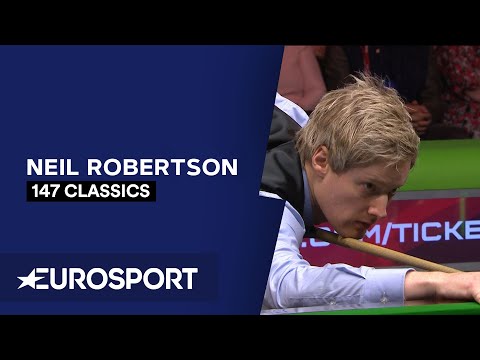
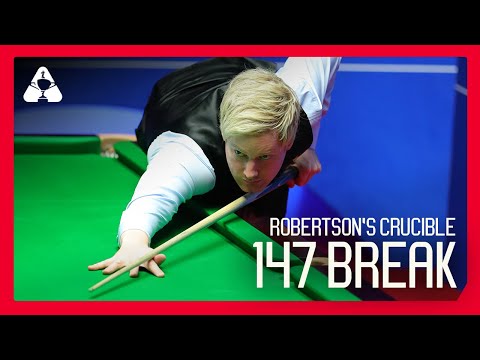
Robertson has made the maximum 147 break in competitive play and has come agonisingly close on numerous other occasions. His consistency as a century-maker reflects his playing style — he rarely settles for small breaks when the opportunity to build a large one presents itself. His long potting, in particular, gives him the ability to start breaks from positions that other players would approach more cautiously.
As Robertson enters the later stages of his career, his century total continues to grow. He passed 800 centuries during the 2021–22 season and shows every sign of reaching, and potentially surpassing, the 1,000-century mark before he retires — which would place him in the most exclusive company in the history of the sport.
At the World Championship
The Crucible holds a special place in Neil Robertson's career story. His 2010 World Championship triumph — defeating Graeme Dott 18-13 in a final that was both compelling and technically excellent — remains the defining achievement of his career and a landmark moment in the tournament's history. As the first overseas player to win the title since Peter Ebdon in 2002, and only the second Australian-born World Champion after Eddie Charlton came close in the 1970s, Robertson's victory carried genuine historical significance.
Beyond his 2010 triumph, Robertson has had a distinguished Crucible record, reaching the final again and making the semi-finals on multiple occasions. He has produced some of his finest individual performances at the tournament, including several extraordinary century breaks under the unique pressure that the Crucible generates. His longevity as a World Championship contender — still capable of reaching the final stages of the tournament in his forties — is remarkable.
Robertson has spoken about the particular atmosphere of the Crucible, and about how the tournament's long-form format rewards his analytical, consistent approach. His record there reflects a player who rises to the occasion on the biggest stage, and who — despite winning the title only once — has contributed enormously to the quality and drama of the tournament across more than two decades of competition.
Career Highlights Videos
Watch Neil Robertson Live
Follow Australia's greatest snooker player on TV and streaming. Check the world rankings for his current position.