Checkout Guide
The art of finishing separates good players from great ones. Learn preferred checkout paths, bogey numbers, and the strategies that professionals use to close out legs.
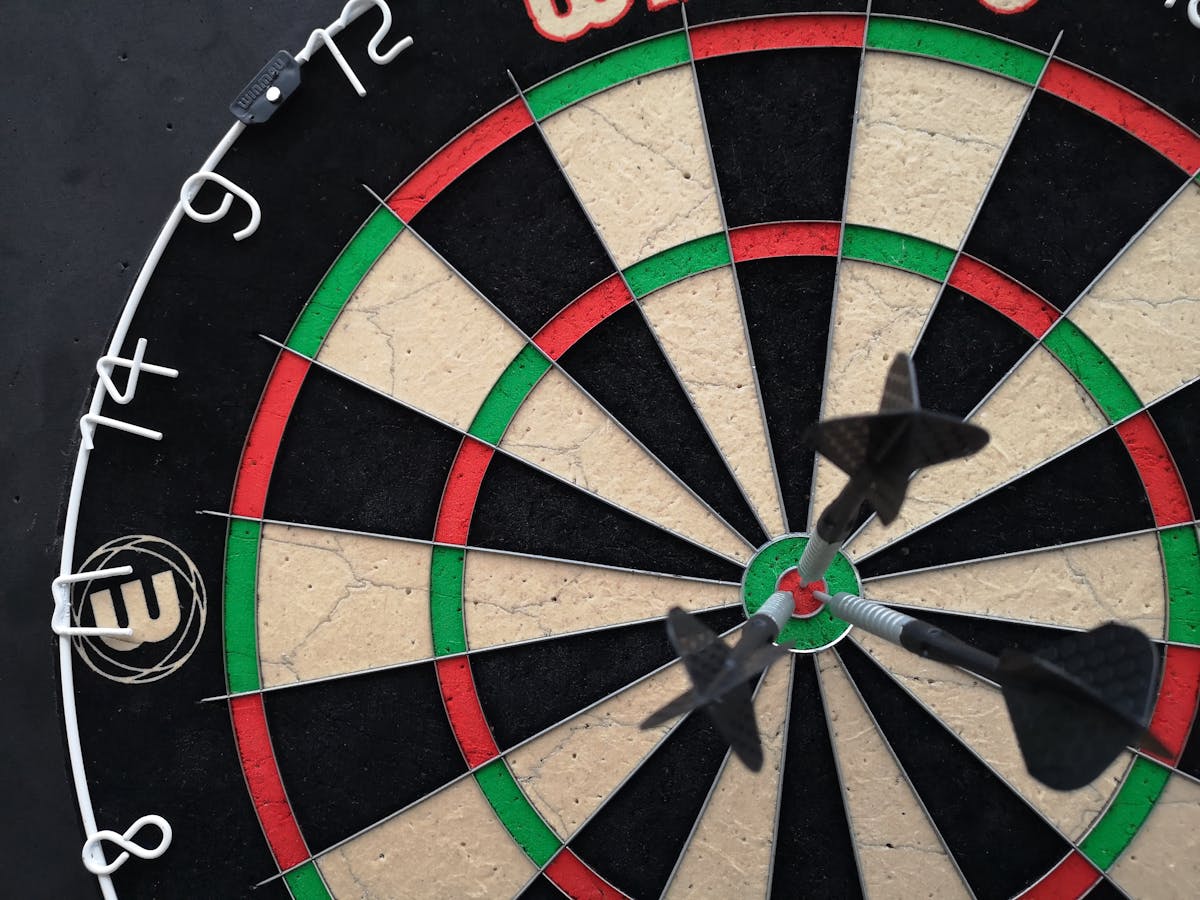
What Is a Checkout?
A checkout in darts is the act of reducing your remaining score to exactly zero, with the final dart landing in a double segment or the inner bullseye. The term "checkout" refers both to the act of finishing and to the specific combination of darts used to do so. For example, "a 120 checkout" means the player scored exactly 120 with their remaining darts to win the leg, with the last dart hitting a double.
The highest possible checkout in a single visit of three darts is 170: treble 20 (60), treble 20 (60), and inner bullseye (50). The lowest is 2: double 1. Every even number from 2 to 170 is theoretically achievable in three darts, though some are considerably harder than others, and a few numbers are impossible to finish on with three darts.
Why 170 Is the Holy Grail
The 170 checkout holds a special place in darts. It is the maximum possible finish, requiring two treble 20s and a bullseye, and it is one of the most celebrated moments in the sport. When a player steps up to the oche with 170 remaining and hits treble 20, treble 20, bull, the crowd erupts, the commentators go wild, and the moment enters the highlight reel.
What makes 170 so special is not just the score but the difficulty. Hitting two treble 20s in succession requires extraordinary accuracy under pressure, and following them with the inner bullseye, a small target in the centre of a board full of previously thrown darts, demands nerve and precision in equal measure. Even the best players in the world convert the 170 checkout only a small fraction of the time they attempt it. Some professionals go entire careers without hitting one on television.
The 170 finish is sometimes referred to as the "Big Fish" and is considered the ultimate show of skill and composure. Notable 170 finishes in darts history include Adrian Lewis's famous checkout in the 2011 World Championship final and Michael van Gerwen's numerous big finishes throughout his career.
Understanding the Checkout Range
A player is said to be "on a finish" when their remaining score can be completed in three darts or fewer. The maximum three-dart finish is 170, so any score of 170 or below (with certain exceptions) puts a player on a potential checkout.
Two-Dart Finishes
Any score of 110 or below can potentially be finished in two darts (the highest two-dart finish being treble 20, bullseye for 110). Common two-dart finishes include 100 (treble 20, double 20), 80 (treble 20, double 10), and 76 (treble 20, double 8). Being able to finish in two darts rather than three saves a dart and puts pressure on the opponent.
Single-Dart Finishes
Any score of 50 or below and even can be finished with a single dart. The most common single-dart finishes are the doubles: 40 (double 20), 32 (double 16), 16 (double 8), and so on down to 2 (double 1). The inner bullseye at 50 is also a single-dart finish.
Bogey Numbers
Bogey numbers are scores that cannot be checked out with three darts. These are numbers that are impossible to reach zero from in a single visit whilst also finishing on a double.
The Key Bogey Numbers
The primary bogey numbers are 169, 168, 166, 165, 163, 162, and 159.
Let us examine why these numbers are bogey numbers:
169: The maximum you can score with two darts whilst leaving a double is treble 20 (60) + treble 20 (60) = 120, leaving 49, which is not a double. There is no combination of two darts that leaves a valid double from 169.
168: Similarly, no combination of two scoring darts from 168 leaves a valid double finish.
166: Treble 20 + treble 20 = 120, leaving 46, which could be finished (single 6, double 20, for example) but that requires four darts total, not three. No two-dart combination leaves a one-dart double.
165, 163, 162, 159: The same logic applies. These totals cannot be reduced to a double with just two preceding darts.
In practice, when a player's score lands on a bogey number, they must throw a scoring dart to move to a non-bogey number and then finish in a subsequent visit. Experienced players plan their scoring to avoid leaving themselves on a bogey number at the end of a visit.
Preferred Checkout Routes
Professional players have well-established preferred routes for checking out from every achievable score. These routes are chosen to maximise the chance of success, taking into account factors such as the size of the target, the safety of missing, and personal preference.
The Principle of "Cover" Shots
A key concept in checkout strategy is the "cover" shot. This means aiming at a target where a near-miss still leaves a useful score. For example, when on 76, the standard route is treble 20 (60), double 8. But if you miss treble 20 and hit single 20 instead, you are left on 56, which is a manageable two-dart finish (single 16, double 20). This is much better than hitting single 18 (leaving 58) or single 5 (leaving 71), which are more awkward.
Why Double 16 Is Favoured
You will notice that many checkout routes are designed to leave double 16 (32) as the final target. There is a very good reason for this. If you miss double 16 and land in the single 16 bed, you are left on 16, which is double 8. If you then miss double 8 into single 8, you are left on 8, which is double 4. Miss that into single 4, and you have double 2. This "halving" sequence means that each miss at a double still leaves you on a double, giving you repeated opportunities to finish.
By contrast, if you are on double 15 (30) and miss into single 15, you are left on 15, which is an odd number and therefore not a double finish. You would need to hit a single odd number first to get back to an even number. This makes double 15 (and other odd doubles) less forgiving than even doubles.
Common Checkout Paths
Below are the preferred checkout routes for some of the most common finishes. These represent the standard approaches used by the majority of professional players, though individual preferences can vary.
| Score | Preferred Route | Notes |
|---|---|---|
| 170 | T20, T20, Bull | The maximum checkout |
| 167 | T20, T19, Bull | Second highest finish |
| 164 | T20, T18, Bull | Three-dart finish required |
| 161 | T20, T17, Bull | Three-dart finish required |
| 160 | T20, T20, D20 | Two treble 20s and tops |
| 158 | T20, T20, D19 | Leaves an odd double |
| 157 | T20, T19, D20 | Preferred over bull routes |
| 156 | T20, T20, D18 | Standard route |
| 152 | T20, T20, D16 | Leaves favourite double |
| 148 | T20, T16, D20 | Some prefer T20, T20, D14 |
| 141 | T20, T19, D12 | Classic nine-darter finish |
| 140 | T20, T20, D10 | Standard route |
| 136 | T20, T20, D8 | Standard route |
| 132 | T20, T16, D12 | Some prefer Bull, T14, D18 |
| 127 | T20, T17, D8 | Avoids the bull |
| 121 | T17, T10, D20 | Various routes available |
| 120 | T20, S20, D20 | Clean and simple |
| 114 | T20, S14, D20 | Keeps options open |
| 110 | T20, Bull | Two-dart finish |
| 107 | T19, Bull | Two-dart finish |
| 104 | T18, Bull | Two-dart finish |
| 100 | T20, D20 | Two-dart finish, clean route |
| 96 | T20, D18 | Standard route |
| 80 | T20, D10 | Standard route |
| 76 | T20, D8 | Leaves good cover |
| 72 | T16, D12 | Some prefer T20, D6 |
| 64 | T16, D8 | Clean halving sequence |
| 56 | T16, D4 | Standard route |
| 50 | S18, D16 | Many prefer S10, D20 |
| 40 | D20 | Single-dart finish, "tops" |
| 36 | D18 | Single-dart finish |
| 32 | D16 | Single-dart finish, most popular double |
| 16 | D8 | Single-dart finish |
| 8 | D4 | Single-dart finish |
| 4 | D2 | Single-dart finish |
| 2 | D1 | The lowest possible finish |
Checkout Strategy: Thinking Ahead
Elite players do not simply react to the score in front of them; they plan their checkouts several darts in advance. When a player reaches a score in the 100-170 range, they are already calculating the optimal route to the double, considering what happens if they miss their intended target.
Setting Up the Double
A critical aspect of checkout strategy is "setting up" the double. This means using your first one or two darts of the visit to leave yourself on a preferred double. For example, if you have 87 remaining, the standard approach is to hit treble 17 (51) to leave 36 (double 18), or single 19 to leave 68, which can then be finished with treble 20, double 4. The choice depends on personal preference and which doubles the player favours.
Adapting to Misses
Professional players are adept at recalculating on the fly. If the first dart of a checkout attempt misses its target, the player must instantly adjust their plan for the remaining darts. For instance, if aiming at treble 20 for a 76 checkout and hitting single 20 instead, the player now has 56 remaining with two darts. They must quickly switch to a 56 checkout route (perhaps single 16, double 20) without losing composure. This ability to adapt in real time is one of the hallmarks of a top-class player.
The Pressure of the "Last Dart in Hand"
There is a notable psychological difference between having three darts at a double and having only one. When a player leaves themselves a two-dart finish, they effectively have only one dart at the "set-up" shot and one at the double. If the set-up shot misses, the dynamic of the checkout changes entirely. This is why many players prefer to approach checkouts in a way that gives them the maximum number of darts at the double.
Checkout Percentage: The Decisive Statistic
A player's checkout percentage measures how often they successfully finish when they have a dart at a double. It is calculated as the number of successful checkouts divided by the number of legs where the player had at least one attempt at a double, expressed as a percentage.
At the professional level, a checkout percentage above 40% is considered excellent. The best players sustain checkout percentages in the 42-48% range across a season. To put this in perspective, this means they are finishing nearly half the time they have a crack at a double, which in the high-pressure environment of professional darts is a remarkable feat.
Checkout percentage is often the deciding factor in close matches. Two players with similar scoring averages will be separated by their ability to finish. A player averaging 98 with a 45% checkout rate will often beat a player averaging 102 with a 30% checkout rate, because the first player is converting more of their opportunities into legs won.
Practising Checkouts
For players looking to improve their checkout ability, targeted practice is essential. Rather than simply throwing at doubles randomly, effective practice involves simulating match conditions.
Start at 100 or 120
A popular practice game is to start at a specific checkout number, such as 100 or 120, and give yourself three darts to finish. Record how many attempts it takes to check out and track your success rate over time. This builds familiarity with the most common checkout routes and develops the muscle memory needed to execute them under pressure.
Doubles Round the Board
Another classic practice routine is "round the board on doubles." Start at double 1 and work your way up to double 20 and the bullseye, throwing three darts at each double before moving on. Track how many you hit out of three and aim to improve your hit rate over time. This ensures you are comfortable on every double, not just your favourites.
Simulate Pressure
Practising in a pressure-free environment is useful for building technique, but it does not fully prepare you for match conditions. Try setting yourself challenges with consequences, such as "if I don't check out 76 in this visit, I have to start the practice routine again." This creates a small amount of pressure that helps train the mental side of finishing.
Summary
The checkout is where darts matches are won and lost. Heavy scoring gets you to the finish line, but it is the ability to hit that final double that determines who takes the leg. By learning the preferred routes, understanding bogey numbers, and practising with purpose, any player can improve their finishing and take their game to the next level. And who knows, with enough practice and a bit of nerve, you might just nail that 170 when it matters most.