1974-75 FA Cup · The Final
1975 FA Cup Final: West Ham United 2-0 Fulham
Two rebounds decided the final, but Alan Taylor's double belongs inside a larger story of six goals in West Ham's last three Cup wins and Fulham's record eleven-match road to Wembley.
Alan Taylor scored twice in four second-half minutes as West Ham United beat Fulham 2-0 at Wembley, ending Fulham's record route and Bobby Moore's final appearance at the stadium.
Saturday 3 May 1975 · Wembley Stadium
What you will not find elsewhere
Taylor scored every West Ham goal in their last three Cup wins
West Ham's last three victories in the run were 2-0 at Arsenal, 2-1 against Ipswich Town in the semi-final replay, and 2-0 against Fulham. Alan Taylor scored all six West Ham goals across those matches. The final double was therefore the last third of one continuous late-round scoring sequence, not an isolated Wembley performance.[1][5][15]
Fulham's record run was eleven matches to the final, twelve including it
Fulham's official history correctly calls it an eleven-match route to Wembley: two replays against Hull City, three against Nottingham Forest and one against Birmingham City made six replays. Adding the final itself makes twelve matches in Fulham's complete FA Cup campaign. Describing the final as the eleventh match drops one of the route games.[8][10][14]
The goals matched in pattern, not in their first shot
Both goals are often compressed into two Mellor rebounds. The first followed a swerving effort from Billy Jennings; Taylor remembered, "In the Final, when the Fulham goalkeeper (Peter Mellor) blocked a shot from Billy Jennings, I was the first to react." The second followed a hard shot from Graham Paddon. Taylor supplied the same decisive reaction, but two different West Ham players created the loose balls.[1][15][16]
The footage
The match report
West Ham United beat Fulham 2-0 in the 1975 FA Cup final at Wembley on Saturday 3 May. The all-London meeting stayed goalless until the second half, when Alan Taylor scored twice in four minutes. Both finishes came after Fulham goalkeeper Peter Mellor could not hold a shot, first from Billy Jennings and then from Graham Paddon. What looks like a neat scoreline was settled by one forward reacting faster than everybody around two loose balls.[1][13][15]
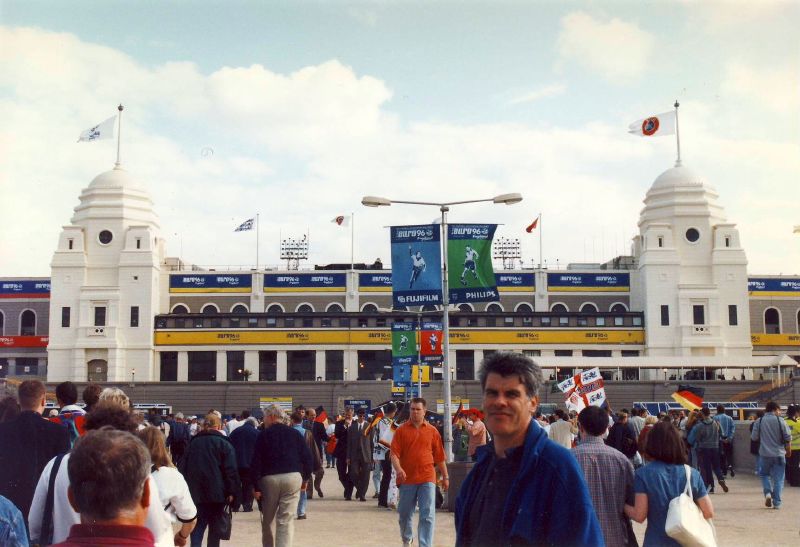
The finalists had arrived by sharply different routes. First Division West Ham needed seven matches, including replays against Swindon Town and Ipswich Town. Second Division Fulham needed eleven before Wembley. Hull City held them across three games, Nottingham Forest across four, and Birmingham City forced a semi-final replay. Fulham therefore played seven times merely to clear the third and fourth rounds. Five days after finally beating Forest at the City Ground, they went to First Division leaders Everton and won. Carlisle United were then beaten away before Birmingham were overcome at the second attempt. The club still describes the route as a record that cannot be surpassed under the old replay system.[1][8][9][10][14]
Taylor was the hinge in West Ham's shorter route. Signed from Fourth Division Rochdale during the winter, he had made only four West Ham appearances, three as a substitute, before his two goals at Arsenal in the sixth round. He scored twice more against Ipswich in the semi-final replay at Stamford Bridge. His Wembley double therefore gave him every West Ham goal in their last three winning matches of the Cup run: six goals against Arsenal, Ipswich and Fulham. It was not a season-long accumulation dressed up as a final flourish; it was one compact sequence that carried John Lyall's side through each decisive late stage.[1][5][15][6]
Fulham had the more promising moments in a restrained first half. Alan Mullery found possession in midfield and John Lacy attacked deliveries from Jim Conway and Mullery, while Trevor Brooking sent a long-range volley over at the other end. Neither goalkeeper was beaten and neither side established sustained control close to goal. The occasion's emotional centre was Bobby Moore, now wearing Fulham white against the club he had captained. This was his final Wembley appearance, at the stadium where his West Ham and England careers had already supplied several defining afternoons.[1][16][11]
At half-time the score was 0-0. Lyall's instruction, as Taylor later recalled it, was simply to keep doing the same things. The manager could also keep Bonds on the field: West Ham's captain had started despite a groin problem that had placed his participation in doubt and feared he might not last the match. Fulham had worked hard without breaking West Ham's shape, and the large, energy-sapping Wembley pitch began to reward the top-flight side's patience after the interval.[1][2][13]
The breakthrough arrived in the 60th minute. Jennings struck a swerving effort that Mellor could only parry into the central danger area. Taylor had followed the shot and reached the rebound first, converting from close range. The move did not require an elaborate passing pattern, but it rewarded the habit Taylor had described as central to his game: pace, alertness and an immediate response to the goalkeeper's block.[1][15][16]
Four minutes later the same pattern returned with different players around it. Paddon drove a hard shot at goal, Mellor failed to hold it, and Taylor followed in for 2-0. He later had a header that might have completed a hat-trick, but the two close-range finishes were enough. Neither manager used the named substitute, so Fulham had to chase the match with the same eleven players who had started it.[1][15][13]
The whistle confirmed West Ham's second FA Cup win. Bonds and his teammates embraced Moore before the captain climbed the Wembley steps with the trophy. The next day, an open-top bus carried the winners through Newham as large crowds greeted them. Fulham have not returned to an FA Cup final, although their long run remains part of the club's own account of its greatest moments. West Ham's victory also opened a European route: Lyall took the side to the following season's Cup Winners' Cup final, where Anderlecht ended the attempt to add another trophy.[1][10][12][4]
How the match unfolded
- pre-matchWest Ham captain Billy Bonds starts despite a persistent groin problem that had made his availability uncertain.[2]
- first halfFulham captain Alan Mullery sees plenty of the ball in midfield, but West Ham keep the Second Division side away from clear openings.[1]
- first halfJohn Lacy threatens with headers from a Jim Conway corner and an Alan Mullery free-kick.[16]
- first halfTrevor Brooking sends a long-range volley over Peter Mellor's goal.[16]
- half-timeThe final remains goalless. John Lyall tells West Ham to continue with the same approach.[1][13]
- 60'Peter Mellor parries Billy Jennings' swerving shot and Alan Taylor converts the rebound to put West Ham ahead.[1][15][16]
- 64'Mellor cannot hold Graham Paddon's powerful shot and Taylor follows in again for his second goal.[1][15][16]
- laterTaylor has a headed chance to complete a hat-trick but does not convert it.[1]
- full-timeWest Ham win 2-0. Bonds and his teammates embrace former West Ham captain Bobby Moore before Bonds lifts the cup.[1][13]
Match facts
Where they played
Both sides as they lined up. Choose any player to read what they did in this final.
Select a shirt for that player's note.
Route to the final
West Ham United
- Third round: Southampton (a) won 2-1
- Fourth round: Swindon Town (h) drew 1-1, replay (a) won 2-1
- Fifth round: Queens Park Rangers (h) won 2-1
- Sixth round: Arsenal (a) won 2-0
- Semi-final: Ipswich Town (Villa Park) drew 0-0, replay (Stamford Bridge) won 2-1
Fulham
- Third round: Hull City (h) drew 1-1, replay (a) drew 2-2 after extra time, second replay (Filbert Street) won 1-0
- Fourth round: Nottingham Forest (h) drew 0-0, replay (a) drew 1-1 after extra time, second replay (h) drew 1-1 after extra time, third replay (a) won 2-1
- Fifth round: Everton (a) won 2-1
- Sixth round: Carlisle United (a) won 1-0
- Semi-final: Birmingham City (Hillsborough) drew 1-1, replay (Maine Road) won 1-0 after extra time
Line-ups
West Ham United · 4-4-2
- Mervyn Day Goalkeeper; kept a clean sheet
- John McDowell Right back
- Tommy Taylor Centre back
- Kevin Lock Centre back
- Frank Lampard Left back
- Billy Bonds Central midfield and captain; played despite a groin problem
- Graham Paddon Central midfield; his shot led to the second goal
- Trevor Brooking Midfield
- Pat Holland Midfield
- Billy Jennings Forward; his shot led to the first goal
- Alan Taylor Forward; scored both goals
Fulham · 4-3-3
- Peter Mellor Goalkeeper; parried the shots that preceded both goals
- John Cutbush Right back
- John Fraser Defender
- Bobby Moore Centre back; former West Ham and England captain making his final Wembley appearance
- John Lacy Defender; threatened with first-half headers
- Alan Mullery Central midfield and captain
- Jim Conway Midfield
- Alan Slough Midfield
- Les Barrett Left-sided forward
- John Mitchell Centre forward
- Viv Busby Forward; had scored decisive doubles against Nottingham Forest and Everton
Trivia and detail
- Fulham had beaten West Ham 2-1 at Craven Cottage in the League Cup earlier in the same season.[17]
- Neither side used its named substitute: Bobby Gould remained on West Ham's bench and Barry Lloyd on Fulham's.[1][15]
- West Ham signed Alan Taylor from Fourth Division Rochdale for £40,000 during the winter of the cup-winning season.[3][15]
- The West Ham starting eleven were all English, the last all-English side to win the FA Cup as of the fiftieth anniversary of the final.[18]
- Bonds said the groin injury had caused him to miss nine of West Ham's final twelve league matches before Wembley.[2]
- West Ham's prose biography says Lyall was appointed manager on 16 April 1974, just over a year before he lifted his first FA Cup as manager.[4]
- Viv Busby scored twice in Fulham's fourth-round decider at Nottingham Forest and twice again at Everton five days later.[8][9]
- Fulham reached the 2010 UEFA Europa League final thirty-five years after their Wembley appearance.[10]
- West Ham reached the European Cup Winners' Cup final in the following season and lost to Anderlecht in Brussels.[4][7]
How well do you know the 1975 final?
Five questions. Every answer is sourced from the material on this page.
-
Who scored both goals in the 1975 FA Cup final?
-
Which Fulham player made his final Wembley appearance in the match?
Answer
Bobby Moore. The former West Ham and England captain Bobby Moore made his last appearance at Wembley for Fulham.[1]
-
How many matches did Fulham play on their route to Wembley, before the final itself?
-
Which goalkeeper parried the shots before both West Ham goals?
-
Who captained West Ham to the trophy?
What is not settled
Honesty matters more than tidiness. These details are contested or unrecorded, and we have not guessed at them:
- West Ham's official match page records Taylor's goals at 60 and 64 minutes and says the second followed four minutes after the first. In the quotation on the same page, Taylor remembered it as five minutes later. The structured scorer times follow the official match record and the independent London Evening Standard listing.
- West Ham's John Lyall biography contradicts itself on his appointment date: the prose says 16 April 1974, while its factfile says 16 August 1974. This record follows the dated prose and avoids using the disputed four-month gap for any further calculation.
- The starting elevens are confirmed by West Ham, RSSSF and the London Evening Standard. No consulted source supplies a contemporary formation diagram. West Ham's 4-4-2 and Fulham's 4-3-3 are reconstructions from the listed roles, and Fulham's front and midfield lines may have shifted during play.
- FA-CupFinals.co.uk carries a useful narrative account of the first-half chances and goal moves, but its Fulham line-up is visibly copied from the 1974 Newcastle side and its referee header is wrong. No line-up or referee claim in this record relies on those corrupted fields.
- No suitably licensed photograph taken during the final was found on Wikimedia Commons. Proposed images are a later Wembley view, later portraits or photographs of relevant club and trophy subjects, all captioned with their true dates.
- An official West Ham United full-match upload returned HTTP 200 through YouTube oEmbed and has been proposed. The record remains in the no-footage state until the separate verifier tests authorised inline playback.
How we know
Every claim on this page is tied to a numbered source below. These are the contemporary records behind it, each one fetched and matched word for word before publication rather than taken on trust:
- Official match history: date, score, attendance, referee, line-ups, goal sequence, Taylor recollections and trophy presentation · West Ham United FC
- Official retrospective: Billy Bonds on his injury, selection, captaincy and respect for Bobby Moore · West Ham United FC
- Official decade history: Moore's departure, Lyall's succession and Taylor's arrival from Rochdale · West Ham United FC
- Official manager biography: appointment, 1975 Cup win and 1976 Cup Winners' Cup final · West Ham United FC
- Official archive feature: QPR tie and Taylor's consecutive doubles against Arsenal, Ipswich and Fulham · West Ham United FC
- Official club history: 1975 victory and following Cup Winners' Cup campaign · West Ham United FC
- Official detailed route history: Hull, Nottingham Forest and Everton matches, scorers and replay workload · Fulham FC
- Official archive report: Alec Stock, first seven route matches, Everton upset and later rounds · Fulham FC
- Official club history: eleven-match route, six replays, Second Division status and final defeat · Fulham FC
- Official FA account: Fulham's only final and the 2-0 defeat by an Alan Taylor double · The Football Association
Where a primary record and a modern account disagree, we show both rather than choosing the tidier number.
Sources
- 1975 - West Ham United 2-0 Fulham · West Ham United FC
- On This Day: Watch West Ham United's 1975 FA Cup final win! · West Ham United FC
- Club history: 1970s · West Ham United FC
- John Lyall · West Ham United FC
- Ironworks Gazette: Professor Brooking of the Educated Feet · West Ham United FC
- The Boys of '75: Tommy Taylor · West Ham United FC
- History of West Ham United · West Ham United FC
- Moments That Made FFC: FA Cup run - 1975 · Fulham FC
- Rewind Report: Fulham's 1975 win at Everton · Fulham FC
- History of Fulham Football Club · Fulham FC
- Mullery's Wembley Memories · Fulham FC
- Emirates FA Cup preview: Fulham v Tottenham Hotspur · The Football Association
- England - FA Cup Finals 1946-2000 · Rec.Sport.Soccer Statistics Foundation
- England - FA Challenge Cup 1974-1975 · Rec.Sport.Soccer Statistics Foundation
- Classic London Cup Finals · London Evening Standard
- 1975 FA Cup Final: West Ham vs Fulham · FA-CupFinals.co.uk
- Fulham football club: record v West Ham United · 11v11
- 3 May 1975, West Ham-Fulham 2-0: the most English FA Cup final · Sky Sport Italia