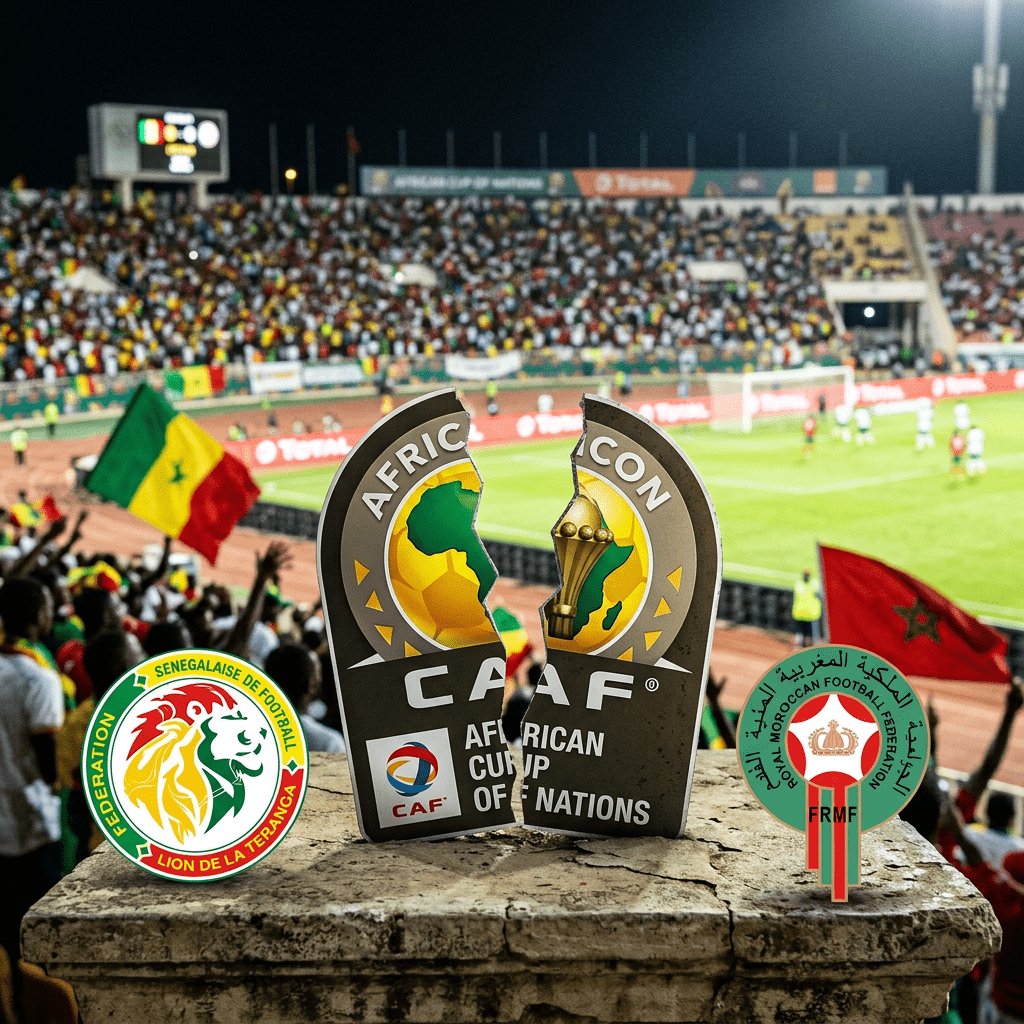
Senegal Demands Corruption Investigation After CAF Strips AFCON Title
Senegal Demands International Corruption Investigation After CAF Strips AFCON Title in Unprecedented Scandal
African football plunged into crisis as the Senegalese government accuses CAF of corruption over the overturned AFCON final — and vows to fight to the very end.
African Football in Crisis
African football has descended into absolute chaos. What should have been a triumphant celebration of Senegal’s back-to-back Africa Cup of Nations titles has instead morphed into the most controversial and politically charged scandal the continent’s game has ever witnessed. The Senegalese government isn’t mincing words — they’re calling for a full independent international investigation into what they’re openly labelling as “suspected corruption” at the Confederation of African Football.
This is seismic. This is a sovereign government effectively accusing African football’s governing body of being corrupt. And after the shambolic events of the past 48 hours, can anyone really blame them?
- Senegal beat Morocco 1-0 in the AFCON final in Rabat in January after extra time
- Senegal’s players walked off for 17 minutes during stoppage time to protest a penalty decision
- They returned, Morocco’s penalty was saved, and Pape Gueye scored the winner
- Three months later, CAF overturned the result and awarded Morocco a 3-0 forfeit victory
- The Senegalese government has called for an international corruption investigation
- The case is heading to the Court of Arbitration for Sport (CAS)
Senegal beat Morocco 1-0 in the AFCON final, fair and square on the pitch, in extra time, in hostile territory. Trophy lifted. Medals distributed. Champions crowned. Except none of that matters anymore — because CAF has decided, three months after the fact, to overturn the result, award Morocco a 3-0 forfeit victory, and hand them the continental crown.
The justification? Senegal’s players walked off the pitch for 17 minutes during stoppage time to protest a penalty decision. Never mind that they came back. Never mind that Morocco’s Brahim Diaz saw his Panenka penalty saved. Never mind that Pape Gueye scored the actual winner in extra time. According to CAF’s appeals board, the moment those players left the field, they forfeited the match.
The Government Steps In
This has gone way beyond football now. The Senegalese government has issued a blistering statement calling CAF’s ruling “unprecedented and exceptionally serious,” based on what they describe as a manifestly erroneous interpretation of the regulations leading to a grossly illegal and deeply unjust decision. They’re not playing diplomatic games. They want answers, and they want an independent investigation into how this decision was reached.
The Senegalese Football Federation is taking it to the Court of Arbitration for Sport. FSF secretary general Abdoulaye Seydou Sow went on national television and didn’t hold back. That’s a federation and a government that smell something rotten and refuse to accept it lying down.
The Perception Problem That Won’t Go Away
Here’s where it gets really uncomfortable for CAF. Raymond Hack, the former head of CAF’s own disciplinary department — yes, their own former disciplinary chief — has publicly questioned the decision and pointed out what everyone’s thinking but many are too polite to say: there’s a massive perception problem when the president of the Moroccan Football Association, Fouzi Lekjaa, also happens to be the first vice-president of CAF.
The referee — Jean Jacques Ndala — allowed play to continue. He didn’t abandon the match. He didn’t declare a forfeit. The players returned, the game resumed, and it was completed. Morocco had their chance to win it from the penalty spot and failed. Senegal scored the winner. That’s how football works. Or at least, that’s how it’s supposed to work.
What Actually Happened in Rabat
Let’s not pretend Senegal’s walkoff was a moment of sporting glory. It wasn’t. It was a protest, and protests have consequences. But context matters here, and the context surrounding that final was absolutely toxic.
Senegal arrived in Rabat already frustrated. They’d complained before the final about refereeing decisions throughout the tournament, with multiple journalists and observers noting that Morocco seemed to benefit from favourable calls. They expressed serious concerns about security arrangements. This wasn’t a team that felt they were getting a fair shake.
Then came the final itself, played in torrential rain, in front of a hostile crowd, with increasingly bizarre incidents piling up. Edouard Mendy, Senegal’s goalkeeper, was trying to dry his gloves in the downpour — standard practice — but ball boys kept trying to discard his towel. At one point, reserve goalkeeper Yehvann Diouf was physically tackled to the ground by three ball boys and dragged around on the floor when he tried to help. Ball boys physically assaulting a player. In a cup final.
Then, deep into stoppage time, Ismaila Sarr thought he’d scored what would have been a late winner for Senegal. Goal disallowed. Moments later, at the other end, referee Ndala was called to the VAR monitor and awarded Morocco a penalty. That’s when Senegal’s players, save for Sadio Mane, had enough and walked off.
Was it the right decision? No. Should there be consequences for walking off? Probably. But should those consequences include overturning the actual result of the match three months later and handing the trophy to the team that lost? Absolutely not. That’s not justice — that’s a power play.
Precedent and Double Standards
The history of walkoffs in football shows just how inconsistent authorities are when dealing with these situations.
- 1920 — Olympic Final Czechoslovakia abandoned the final against Belgium after 40 minutes. They were disqualified and Belgium got the gold — but football governance barely existed at the time.
- 2007 — Lille vs Man United Lille’s players walked off after Ryan Giggs scored while they arranged their wall. They returned, finished the match, and UEFA fined them £42,000. No forfeit.
- 2013 — AC Milan Friendly Kevin-Prince Boateng led Milan off after racial abuse. FIFA applauded his principles. No forfeit.
- 2020 — PSG vs Istanbul Basaksehir Both teams walked off after allegations of racist language from the fourth official. The match was replayed the next day. No forfeit, no 3-0 defeat.
- Feb 2026 — Cameroonian Super Cup Colombe Sportive du Sud walked off after a controversial penalty and red card. Match abandoned — authorities still deciding what to do. No rush to forfeit.
- 2024 — Turkish Super Cup Fenerbahce deliberately fielded an under-19 side and walked off after one minute. They were fined and given a 3-0 forfeit — but that was a premeditated act, not a heat-of-the-moment protest.
So why is Senegal being treated differently? Why is their punishment so much more severe than precedent would suggest? That’s the question hanging over this entire mess, and it’s why the corruption allegations have teeth.
CAF’s Defence Rings Hollow
CAF president Dr Patrice Motsepe has tried to wrap this in the language of integrity and governance, insisting that no single country in Africa will be treated more favourably than any other.
The problem is, that’s exactly how it looks. Morocco, whose FA president is CAF’s first vice-president, hosted the tournament. Their ball boys assaulted opposition players. Their fans shone lasers at opponents — and CAF actually reduced the fine for that. And when they lost on the pitch, they got the result overturned in a boardroom. If that’s not preferential treatment, what is?
The Players Won’t Forget
Whatever CAS eventually decides — and it could take six months — Senegal’s players aren’t giving up their medals without a fight. Everton midfielder Idrissa Gueye posted on social media that his team knows what they experienced that evening in Rabat, and that nobody can take that away from them.
That’s the voice of a player who knows what he and his teammates achieved. They won that match. They scored the goal that mattered. They lifted the trophy. And no boardroom decision, however politically motivated, can erase what happened on the pitch.
A Wider Crisis for African Football
This scandal has exposed deep structural problems within CAF. The perception of bias, the lack of transparency, the inconsistent application of rules, the sense that political connections matter more than what happens on the pitch — it all feeds into a narrative that African football governance is broken.
FIFA president Gianni Infantino weighed in after the original match, saying it was unacceptable to leave the field of play in that manner, and that such scenes must be condemned. That prompted IFAB, football’s lawmaking body, to open a consultation on how to handle player walkoffs. That’s fine — walkoffs are a problem that needs addressing. But using Senegal as the test case for a draconian new interpretation of the rules feels like scapegoating.
North African journalist Maher Mezahi summed up the broader mood: the rest of Africa feels outraged because it appears that once again, the Confederation of African Football has almost disgraced the sport. He pointed to CAF’s history of questionable decisions, including banning Togo from two AFCONs for withdrawing from the 2010 tournament — after their team bus was attacked by gunmen in Angola, leaving three people dead.
What Happens Next
Senegal will take this to CAS. Morocco will defend their newly awarded title. CAF will insist they followed procedure. The Senegalese government will continue pushing for an international investigation into corruption. And the rest of us will watch this unfold over the next six months, wondering how African football got to this point.
The tragic thing is that both Senegal and Morocco have brilliant teams that deserved better than this. Senegal, the defending champions who won in 2021 and fought through adversity to reach another final, have had their achievement tarnished. Morocco, who hosted a largely successful tournament and played some excellent football, will forever have an asterisk next to this title.
But the biggest loser is African football itself. Every day this drags on, every new accusation of corruption, every piece of evidence suggesting political interference — it all chips away at the credibility of the game on the continent. CAF needed to be beyond reproach in handling this situation. Instead, they’ve created the biggest governance crisis in African football history.
Senegal won that match. Everyone who watched it knows that. Whether CAF’s appeals board or the Court of Arbitration for Sport eventually acknowledges it is almost beside the point now. The damage is done. The questions have been asked. And until there are satisfactory answers, the shadow of corruption will hang over this entire sorry episode.