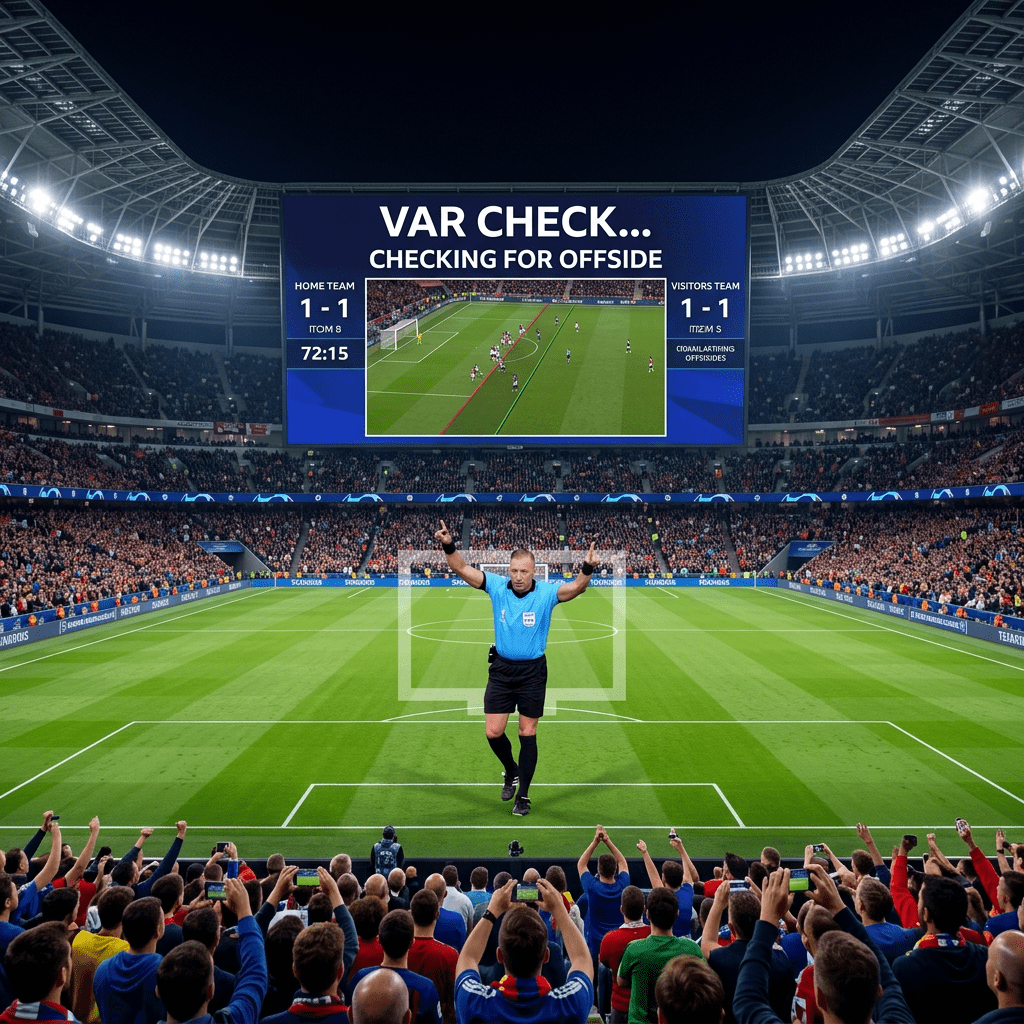
UEFA Demands VAR Reset
This analysis examines UEFA’s intervention in the VAR debate, drawing on specific Premier League controversies to illustrate the “microscopic” approach that has prompted Roberto Rosetti’s summit. It contrasts domestic league overreach with UEFA’s more nuanced philosophy — forensically accurate on objective decisions like offside, but restrained on subjective calls.
It outlines concrete reforms the summer meeting must deliver to restore VAR’s original purpose.
VAR should catch howlers, not analyse freeze-frames like a forensics lab. That’s UEFA’s blunt message this summer. Roberto Rosetti heads UEFA’s referees. He’s gathering top brass from Europe’s five big leagues.
The summit will bring together referee chiefs from the Premier League, La Liga, Serie A, the Bundesliga and Ligue 1. It shows VAR has strayed far from its job. Fans were promised a safety net for “clear and obvious errors”. Instead, it’s become a microscope trained on every pixel and millimetre. Officials now find something, anything, to justify stepping in.
When Clear and Obvious Became Microscopic and Pedantic
The English game has given Rosetti plenty of ammunition. Arsenal’s disallowed goal against Manchester United at Old Trafford showed the overreach perfectly. Eddie Nketiah’s finish was ruled out after VAR officials spotted a possible foul. The contact was so minimal that in real time it barely registered. The referee hadn’t blown his whistle. Yet frame-by-frame analysis turned a coming-together into a “clear and obvious error”. That’s not error correction. It’s error creation.
And it’s only got worse. This season alone has seen the microscope dialled up to absurd levels. Aston Villa’s winner against Liverpool in December was chalked off after VAR spent nearly four minutes examining Ollie Watkins’ shoulder. Was it ahead of the last defender three phases before the goal? The freeze-frame analysis needed multiple angles and digital assistance.
Then there was the Manchester City versus Chelsea mess in January. A penalty was awarded for handball against Marc Cucurella. VAR overturned it after deciding the ball had brushed his sleeve rather than his arm proper. This distinction needed slow-motion replays at one-eighth speed and medical-textbook precision about where “arm” ends and “sleeve” begins.
Liverpool have been on both sides of the microscope. The Merseyside derby saw a goal chalked off for an offside measured in pixels — Jordan Henderson’s shoulder ahead of the last defender by a margin so small it needed digital lines that themselves carry a margin of error. Then there was the Tottenham mess where VAR somehow forgot to draw the lines for Luis Díaz’s legitimate goal. The error was so bad it prompted an audio release and a formal apology.
Newcastle’s goal against Arsenal was disallowed because Joelinton’s trailing arm made contact with an Arsenal defender. Was it a foul? In isolation, perhaps. Was it clear and obvious? Not remotely. In the flow of the game it was nothing. But VAR’s freeze-frame gave officials the excuse to step in.
UEFA’s Growing Alarm at Domestic Divergence
What’s pushed Rosetti to convene this summit isn’t just these decisions existing. It’s the growing gap between how VAR works in domestic leagues versus UEFA competitions. It’s not about how often VAR steps in, but how it steps in.
| Aspect | UEFA / Champions League | Domestic Leagues (esp. PL) |
|---|---|---|
| Interventions/match | ~0.45 (higher rate) | ~0.27 (lower rate) |
| Offside technology | SAOT — seconds, automated | Manual line-drawing — minutes, subjective |
| Subjective calls (fouls) | High threshold — restrained | Low threshold — forensic on everything |
| Slow-motion usage | Sparingly on fouls | Routinely — distorts natural contact |
| Philosophy | Forensic on objective, trust refs on subjective | Microscopic on everything |
Recent data shows the paradox. The Premier League records fewer VAR interventions per match — about 0.27 compared to the Champions League’s about 0.45. Yet Premier League interventions feel more intrusive, more pedantic, more soul-destroying. Why? Because domestic leagues have embraced the microscope for everything. UEFA has kept a clear distinction between objective and subjective decisions.
UEFA’s approach has stayed closer to the original protocol, but with a twist. For objective decisions — especially offside — UEFA’s Semi-Automated Offside Technology is more forensic and pixel-perfect than the Premier League’s manual lines. The gap is speed and certainty. SAOT delivers its verdict within seconds using dedicated tracking cameras, cutting out the agonising wait whilst officials manually draw lines on broadcast footage.
But for subjective decisions — fouls, handballs, the grey areas — UEFA has kept real restraint. VAR steps in sparingly on these calls, reserving involvement for genuinely missed incidents where the on-pitch official has clearly got it wrong. The threshold stays high because Rosetti’s team grasps something domestic leagues appear to have forgotten: football is an imperfect game officiated by imperfect humans. On subjective calls, that’s acceptable.
The Bundesliga has followed a similar philosophy. VAR officials are told to trust on-pitch referees unless an error is genuinely significant. Germany’s approach stresses speed of decision and minimal disruption, resulting in fewer pedantic interventions and greater acceptance from fans.
By contrast, the Premier League’s use has become meddling on every decision type. Attacking moves are forensically examined for possible fouls five passes before the goal. Subjective decisions that were always meant to stay with the on-pitch official are being re-refereed from a lorry in Stockley Park. La Liga and Serie A have fallen somewhere between these extremes — both have had their own microscopic moments, suggesting the contagion is spreading.
What the Summer Summit Must Deliver
Rosetti’s summit can’t be another talking shop. The agenda needs concrete reforms, not platitudes about “improving communication” or “refining the process”. Three areas demand immediate attention.
If multiple replays from multiple angles at multiple speeds are needed, it’s not clear and obvious. Full stop. UEFA should mandate a maximum review time — say, 45 seconds. After that, if no clear error has been found, the on-pitch decision stands.
This would put Rosetti at odds with IFAB tradition. The rule-makers have historically resisted “shot clocks” for referees, believing it undermines their authority. But desperate times demand bold measures. A hard time limit would cut out the forensic archaeology plaguing domestic leagues and force VAR to focus on genuinely clear errors.
The original VAR protocol stated that subjective calls should only be overturned when the on-pitch decision was clearly wrong. Not when it was “possibly wrong” or “arguably wrong”. Rosetti needs to reassert this principle and ensure domestic leagues enforce it. Slow-motion should be banned entirely for subjective foul assessments — it distorts natural contact into violent conduct.
Fans deserve real-time explanations during matches, similar to rugby’s system where the referee’s process is broadcast to the stadium and viewers. The current approach — silent interventions followed by cryptic graphics — breeds conspiracy theories and erodes trust. The summit should also mandate Semi-Automated Offside Technology for domestic leagues, retiring the Premier League’s manual line-drawing exercise.
Resetting Expectations, Restoring Sanity
What’s at stake here isn’t just VAR’s reputation. It’s football’s watchability. Fans are conditioned to celebrate goals with hesitation. They wait for the check, the microscopic examination, the possible intervention. That’s not how football should feel. Goals are meant to explode with immediate joy — not simmer with anxiety whilst officials search for reasons to step in.
Rosetti grasps this because UEFA competitions have largely avoided the worst excesses on subjective calls. Champions League matches still flow. Decisions are made with authority. VAR steps in when something genuinely wrong has occurred, then retreats back into the background where it belongs.
The summer summit is a chance to export that philosophy back to domestic leagues. To remind everyone — referees, clubs, broadcasters, fans — what VAR was meant to be. A corrective tool for howlers, not a microscope for minutiae.
Whether Europe’s top leagues are willing to surrender their forensic approach remains the question. They’d need to trust on-pitch officials again. Roberto Rosetti knows it. UEFA knows it. This summer, in whatever conference room hosts this summit, the domestic leagues need to relearn it.
They must act before VAR strangles the spontaneity out of football altogether.