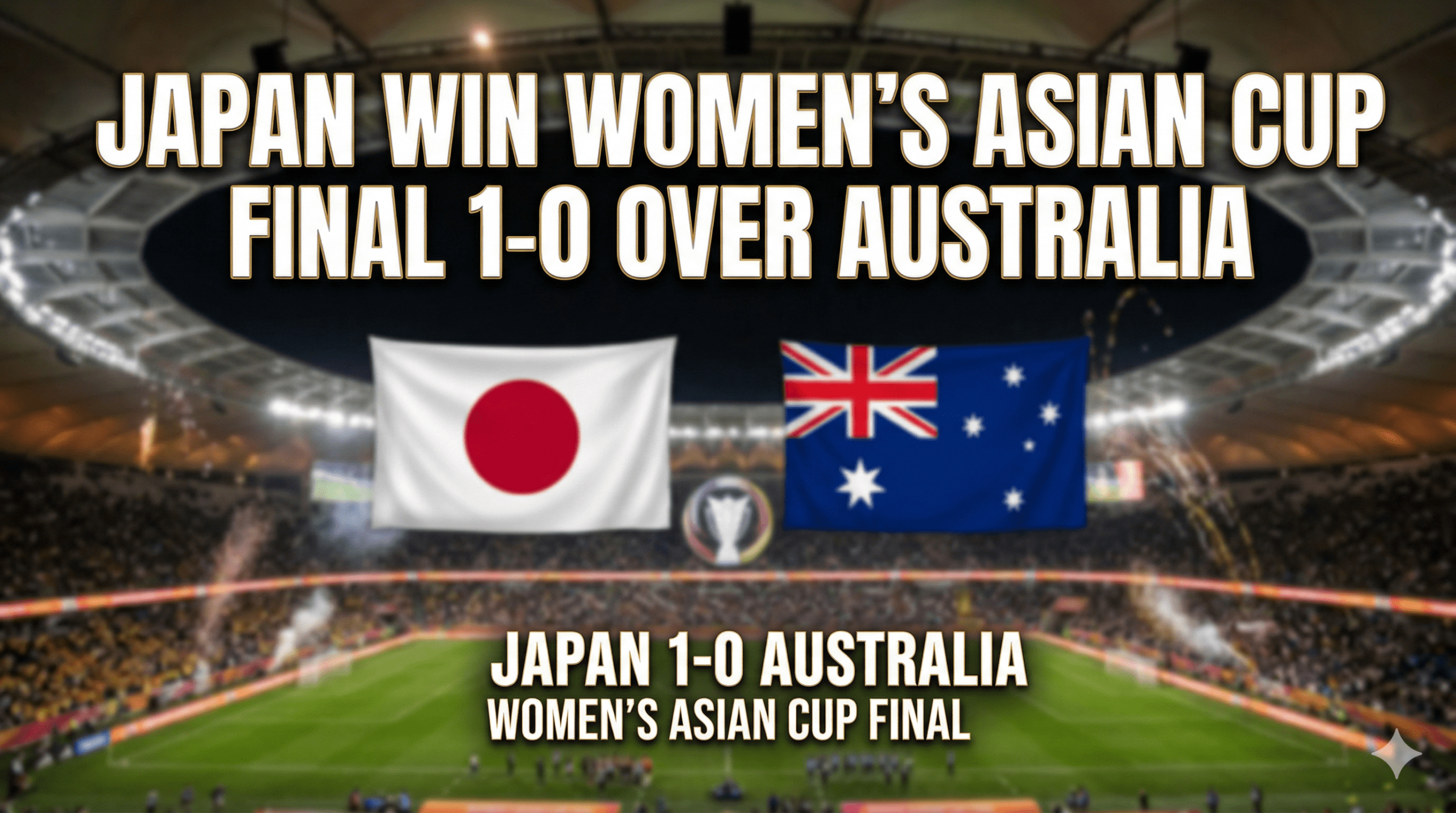
Hamano’s Wonder Strike Seals Japan’s Asian Cup Glory
This report explores Australia’s third consecutive 1-0 Women’s Asian Cup final defeat to Japan, examining the psychological weight of this rivalry and Japan’s continued dominance in Asian women’s football through the lens of a historic night at Stadium Australia.
The Curse Strikes Again
There were 74,397 souls packed into Stadium Australia, a record crowd for any Women’s Asian Cup match, and they came to witness history. What they got instead was heartbreak served in the most familiar of fashions: a brutal reminder that some fixtures carry curses that home advantage simply cannot lift.
Maika Hamano, the 21-year-old Chelsea loanee currently plying her trade at Tottenham Hotspur, delivered the dagger in the 17th minute. The strike was spectacular, the type of goal that silences 74,000 voices in an instant. Receiving the ball with her back to goal from the left, Hamano turned and unleashed a swerving effort from distance that arrowed into the opposite bottom corner, leaving Mackenzie Arnold rooted to the spot.
It was a moment of individual brilliance that settled what became an absorbing, end-to-end encounter. More significantly, it condemned Australia to their third consecutive Asian Cup final defeat to Japan, all by that same cruel 1-0 scoreline. The 2014 and 2018 finals had ended identically. Same opponent, same result, same agony.
Japan’s Dynasty Continues
This was Japan’s third Women’s Asian Cup title, adding to their continental crowns from 2014 and 2018. It marked their third title in four editions of the tournament, a run of dominance that has established the Nadeshiko as the pre-eminent force in Asian women’s football over the past decade.
The manner of the victory will only enhance their reputation. Japan arrived in Australia having demolished opponents throughout the tournament, thumping India 11-0 in the group stage and registering 7-0 and 4-1 victories over Philippines and South Korea. They had scored goals for fun, played with verve and invention, and looked every inch the tournament favourites.
Australia’s Agony: So Close, Yet So Far
Caitlin Foord, the Arsenal winger who had scored Australia’s opening goal in their semi-final victory over China, endured a torrid evening. She spurned a trio of first-half opportunities, the best of which came in the 35th minute. Japanese keeper Ayaka Yamashita passed the ball straight to the Matildas forward inside the box, but Foord’s lashed effort flew well wide of the target in a huge let-off for Japan. Foord had another chance in first-half stoppage time but again dragged her shot wide of the target with the goal begging.
Those misses would prove costly. In finals of this magnitude, chances must be taken, and Australia’s profligacy in front of goal ultimately cost them dearly. As the match wore on, the Matildas upped the tempo, throwing bodies forward in search of an equaliser. Hayley Raso came close after a brilliant run and cross from Foord, only to be denied by a superb last-ditch intervention from Rion Kitigawa.
The Historical Weight of Defeat
This defeat carries particular sting because of the historical context. Australia and Japan have now met in three Asian Cup finals, and the pattern has been depressingly consistent from an Australian perspective. Japan have won all three encounters, each time by a 1-0 margin, each time finding a way to break Australian hearts.
The parallels to Australia’s 2023 World Cup campaign are unavoidable. The defining clashes between these nations came in the 2014 and 2018 editions of the Women’s Asian Cup, when Japan beat Australia 1-0 both times in the final. For all the progress Australian women’s football has made, the Matildas still cannot get over the line when it matters most.
What This Means for Japan’s Future
This third Women’s Asian Cup title confirms Japan’s status as the dominant force in Asian women’s football. More than that, it demonstrates their ability to evolve and adapt. This 2026 side has shown they can do it all, blending attacking flair with defensive solidity. Japan are the only Asian team to have won the Women’s World Cup, and this triumph suggests they are building towards another tilt at global glory.
The squad depth is remarkable. Japan showcased their quality across the tournament, with 14 different goal scorers across their AFC Women’s Asian Cup Australia 2026 campaign. That spread of goals indicates a team with multiple threats, a side that cannot be nullified by simply marking one or two key players.
The Matildas’ Reckoning
For Australia, this defeat poses difficult questions. Joe Montemurro’s side have the talent, the home support, and the hunger to succeed. What they lack is the ability to convert that into silverware. The edge-of-the-seat decider culminated a landmark tournament with more than 350,000 fans through the turnstiles, reinforcing the growth in popularity of the women’s game.
Japan, meanwhile, celebrate another continental crown, their third title adding to their previous success in 2014 and 2018. They have established themselves as Asia’s pre-eminent footballing nation, and on this evidence, they will take some shifting from that perch. For Australia, the search for answers continues. The curse of three finals remains unbroken.