1992-93 FA Cup · The Final
1993 FA Cup Final: Arsenal 1-1 Sheffield Wednesday (won after a replay)
The last replay final
Separate contemporary reports for the draw and the replay reveal a final remembered for one late header but shaped by two different selection changes and two different ways of recording a goal minute.
Arsenal and Sheffield Wednesday needed two matches and extra time twice before Andy Linighan headed the last replayed FA Cup final out of reach of a penalty shoot-out.
Saturday 15 May 1993 · Wembley Stadium
What you will not find elsewhere
The goal minutes disagree by one because the sources are counting differently
Modern match databases label the drawn final's goals at 20 and 61. The contemporary Independent report describes the same goals as coming after 21 and 62 minutes. The replay supplies the control: its database label is Wright 34, while the newspaper says he scored after 33 minutes. The pattern points to elapsed-minute labels in one source and the ordinal minute of play in the other, not three separate timing disputes. This record uses the elapsed-minute labels in its timeline and preserves the newspaper convention instead of presenting one set as an error.[1][3][7][10]
The same opponents played 330 minutes of Wembley finals in one season
Add the League Cup final to the drawn FA Cup final and its replay and Arsenal met Sheffield Wednesday in three Wembley cup-final matches across 330 minutes. Arsenal's aggregate was 5-3, but only the final minute of that whole sequence gave them the FA Cup. Each club also played an FA Cup semi-final at Wembley, so both made four trips to the same ground in six weeks.[16][1][3][15]
Two changes turned a stalled first match into a more open replay
The first match's substitutions made both teams more defensive: Wright went off for O'Leary and Anderson's injury pulled Palmer into the back line. The replay began with the opposite idea. Arsenal added Smith as a striker, while Wednesday replaced the injured Anderson with midfielder Wilson and moved Palmer into defence from the start. The replay then produced more chances and a winner, although it still took the full two hours.[1][3][10]
Worthington remembered a final decided by the last kick
Nigel Worthington's later FA interview compresses the two-match final without flattening it. He remembered two great games that ran to the last kick of extra time before Arsenal prevailed. The verified wording matters because it comes from a Sheffield Wednesday player who completed both matches, and because Andy Linighan's header was effectively the final act of the last FA Cup final ever settled by a replay.[14][3]
The footage
The match report
Arsenal and Sheffield Wednesday arrived at Wembley with the uncomfortable familiarity of teams repeating a final. They had met there in the League Cup the previous month, when Arsenal won 2-1, and now became the first pair to contest both English domestic cup finals in the same season. Both had also played an FA Cup semi-final at Wembley. The first match of this final therefore gave each club a third visit to the ground in six weeks, with the replay still to come.[16][15][12]
The routes had already tested both sides beyond their Wembley derbies. Arsenal survived a 2-2 home draw with Leeds and won the replay 3-2 after extra time, then scored six goals across away wins at Yeovil and Ipswich before edging Tottenham 1-0 in the semi-final. Wednesday also needed a quarter-final replay after drawing 3-3 at Derby and winning 1-0 at Hillsborough, then beat city rivals Sheffield United 2-1 after extra time. Neither route was a procession: each finalist arrived after one replay and one extra-time tie. Wednesday's semi-final had itself required extra time at Wembley, whereas Arsenal's north London derby was settled in normal time.[11][15]
The drawn match began with Wednesday making the clearer chances. Carlton Palmer's header and Chris Waddle's free-kick both required David Seaman saves, but Arsenal took control as Nigel Winterburn advanced from left back and Paul Davis restricted John Sheridan. The lead came from a set piece: Davis delivered, Andy Linighan headed across goal and Ian Wright finished at the far post. It was the first of two goals Wright would score across this tie.[1][7]
Wednesday's reply also came through a chain of headers. Sheridan crossed, Mark Bright flicked the ball on, John Harkes returned it into the danger area and David Hirst drove past Seaman with his left foot. Both scorers had arrived short of full fitness: Wright had broken a toe and Hirst was still working back from injury. Their ability to finish rescued a match in which neither midfield created enough. The contemporary account describes deliberate cancellations: John Jensen followed Waddle, Davis shadowed Sheridan, and Paul Warhurst played at centre-back rather than continuing as Wednesday's emergency striker. That helps explain why both goals grew from aerial second balls instead of a clean pass through midfield.[1][2]
A late Woods save from Wright forced extra time, but the substitutions made the match still more cautious. Anderson's injury moved Palmer into the Wednesday defence, while David O'Leary replaced Wright for Arsenal. No further goal came. After 120 minutes the score remained 1-1, and the players were told to return to the same ground five days later.[1][7][10]
Both managers changed the balance for the replay. Arsenal promoted Alan Smith and left out Ray Parlour, shifting Kevin Campbell away from the centre. Wednesday lost Anderson after a fitness test on his bruised knee, moved Palmer into central defence and put Danny Wilson into midfield. The night brought wintry rain, and a motorway accident delayed thousands travelling south and pushed the kick-off back by half an hour.[3][12]
The changes opened the match. Smith's flick released Wright to beat Palmer and Warhurst before clipping the ball across Woods for the first goal. Wednesday answered after the interval: Harkes crossed from the right, the Arsenal defence did not clear and Waddle's shot travelled in off Dixon. Bright then missed the clearest chance to give Wednesday the lead, shooting wide with only Seaman to beat.[3][12]
Extra time brought chances at both ends and the first penalty shoot-out in a Wembley final moved closer. Then Paul Merson took a corner in the final minute. Linighan, already playing with a broken nose after a challenge from Bright, rose above the defence and headed through Woods' attempt to save. One minute later penalties would have begun. Instead Arsenal won 2-1 and Sheffield Wednesday ended a season of admired football with two cup-final defeats to the same opponent.[3][12][14]
The result made Arsenal the first English club to win the FA Cup and League Cup in one season. It was their sixth FA Cup and George Graham's second major trophy of the campaign. For the competition it was also an ending: no later final went to a replay. The rule survived for several more seasons, but when the next final finished level the cup was settled on the day.[12][15][18]
How the match unfolded
- opening minutesCarlton Palmer heads a John Sheridan corner beneath the bar and David Seaman pushes it away. Seaman then turns Chris Waddle's free-kick over.[1]
- 20'Ian Wright puts Arsenal ahead. Paul Davis sends in a free-kick, Andy Linighan heads it across goal and Wright heads in at the far post.[7][1]
- 61'David Hirst equalises for Sheffield Wednesday. Sheridan crosses, Mark Bright and John Harkes keep the move alive with headers, and Hirst drives a left-footed shot past Seaman.[7][1]
- 66'Arsenal replace Ray Parlour with Alan Smith.[7][1]
- 85'Viv Anderson leaves with a leg injury and Graham Hyde replaces him, forcing Carlton Palmer back into the Wednesday defence.[7][1]
- one minute before normal time endsWright meets a head-high ball across the Wednesday penalty area, but Chris Woods deflects the volley over and the match goes to extra time.[1]
- 90'David O'Leary replaces the injured Wright as extra time begins.[7][1]
- 112'Chris Bart-Williams replaces Waddle during extra time.[7]
- after extra timeThe first match ends 1-1 and the cup remains undecided. A replay is required at Wembley five days later.[1][10]
The replay
Five days after the draw, the teams returned to Wembley on a wet Thursday night. A motorway accident delayed the kick-off by half an hour, two starting places changed, and another two hours of football were needed before Andy Linighan settled the last replayed FA Cup final.
- Date
- Thursday 20 May 1993
- Venue
- Wembley Stadium
Changes from the first match
- Alan Smith started at centre forward in place of Ray Parlour. George Graham wanted a more attacking shape after the first match had stalled.[3][10]
- Danny Wilson came into midfield and Carlton Palmer moved back into central defence in place of Viv Anderson. Anderson failed a late fitness test on a bruised knee.[3][10]
- 16'Alan Smith releases Paul Merson in the inside-left channel, but Merson's shot is weak and Chris Woods saves.[3]
- 25'Lee Dixon crosses from the right and Andy Linighan heads wide from close range.[3]
- 34'Ian Wright beats Palmer and Warhurst before clipping the opening goal past Woods.[3][12]
- 62'Graham Hyde replaces Danny Wilson for Sheffield Wednesday.[3][10]
- 68'Chris Waddle equalises with a shot that deflects off Lee Dixon after John Harkes crosses from the right.[3][12]
- 71'Mark Bright has a clear chance to put Wednesday ahead but shoots wide.[3]
- 81'David O'Leary replaces Wright in what becomes O'Leary's final competitive appearance for Arsenal.[3][12]
- 118'Chris Bart-Williams replaces Roland Nilsson as penalties approach.[3][10]
- 119'Linighan heads Merson's corner over the line to win the cup for Arsenal before a shoot-out can begin.[3][12][14]
Match facts
- Date
- Saturday 15 May 1993
- Venue
- Wembley Stadium, London
- Half-time
- 1-0
- Competition
- 1992-93 FA Cup
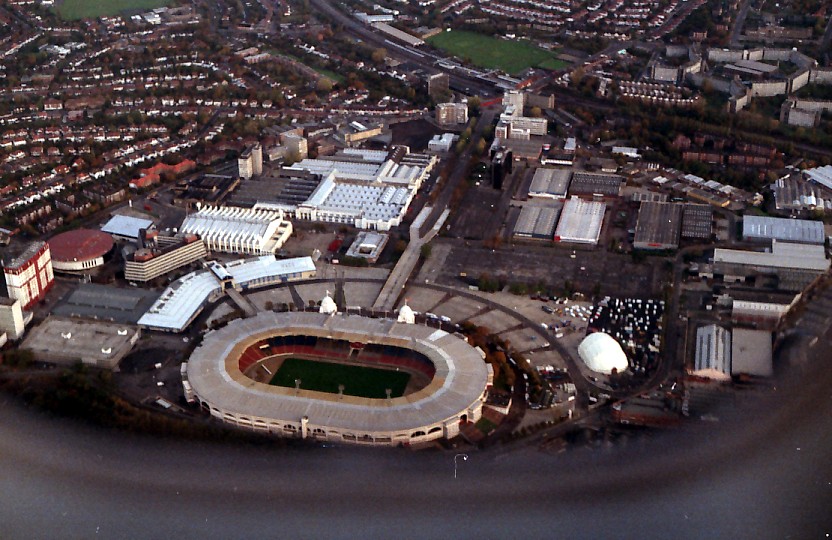
Where they played
Both sides as they lined up. Choose any player to read what they did in this final.
Select a shirt for that player's note.
Route to the final
Arsenal
- Third round: Yeovil Town (a) won 3-1
- Fourth round: Leeds United (h) drew 2-2, replay (a) won 3-2 after extra time
- Fifth round: Nottingham Forest (h) won 2-0
- Quarter-final: Ipswich Town (a) won 4-2
- Semi-final: Tottenham Hotspur (Wembley) won 1-0
Sheffield Wednesday
- Third round: Cambridge United (a) won 2-1
- Fourth round: Sunderland (h) won 1-0
- Fifth round: Southend United (h) won 2-0
- Quarter-final: Derby County (a) drew 3-3, replay (h) won 1-0
- Semi-final: Sheffield United (Wembley) won 2-1 after extra time
Line-ups
Arsenal · 4-4-2
- David Seaman Goalkeeper. Saved early from Carlton Palmer and Chris Waddle
- Lee Dixon Right back
- Andy Linighan Centre back. Headed the ball across goal for Wright's first-match opener
- Tony Adams Centre back and captain
- Nigel Winterburn Left back
- Ray Parlour Right midfield. Replaced by Alan Smith during the second half
- Paul Davis Central midfield. His free-kick began the opening-goal move
- John Jensen Central midfield. Detailed to contain Chris Waddle
- Paul Merson Left midfield
- Kevin Campbell Forward
- Ian Wright Forward. Scored in both matches and left the first with a leg injury
Sheffield Wednesday · 4-4-2
- Chris Woods Goalkeeper
- Roland Nilsson Right back
- Paul Warhurst Centre back, after also playing as a striker during the season
- Viv Anderson Centre back and captain. Replaced after suffering a leg injury
- Nigel Worthington Left back
- Chris Waddle Right midfield. Replaced during extra time
- Carlton Palmer Central midfield before dropping into defence after Anderson left
- John Sheridan Central midfield. His cross began the equalising move
- John Harkes Left midfield. Headed the ball into Hirst's path for the equaliser
- David Hirst Forward. Scored the first-match equaliser
- Mark Bright Forward. Headed on in the equalising move
Trivia and detail
- The two clubs met in three Wembley cup-final matches that season: the League Cup final, the drawn FA Cup final and the FA Cup final replay. Arsenal's aggregate score across 330 minutes was 5-3.[16][1][3]
- The replay was David O'Leary's final competitive appearance for Arsenal. He had joined the club as an apprentice in 1973 and finished with the club appearance record.[12][13]
- Alan Smith received the only yellow card of his professional career during extra time in the replay.[12]
- The replay crowd of 62,267 was the smallest recorded for an FA Cup final at the original Wembley.[12][15]
- The first match was the first FA Cup final in which players wore persistent squad numbers and names on their shirts, after the system had been trialled in the League Cup final between the same clubs.[17][18]
- John Harkes became the first United States player to appear in an FA Cup final.[18]
- Ian Wright was the 1992-93 FA Cup's leading scorer, with 10 goals in seven appearances. His two goals across the final matches completed that total.[8][9]
- Steve Morrow scored Arsenal's League Cup final winner against Wednesday but missed both FA Cup final matches after fracturing his right arm when Tony Adams accidentally dropped him during the Wembley celebrations. Morrow received his League Cup medal immediately before the drawn FA Cup final.[5][6]
How well do you know the 1993 final?
Five questions. Every answer is sourced from the material on this page.
-
Who scored Arsenal's winning goal in the replay?
-
Who equalised for Sheffield Wednesday in the drawn first match?
-
Which Arsenal player started the replay in place of Ray Parlour?
-
Why was the replay kick-off delayed?
-
What domestic achievement did Arsenal complete with the replay win?
What is not settled
Honesty matters more than tidiness. These details are contested or unrecorded, and we have not guessed at them:
- Goal-minute notation differs systematically. 11v11 and modern tables label the first-match goals 20 and 61, while the contemporary Independent report says they came after 21 and 62 minutes. In the replay, the tables label Wright's goal 34 while the newspaper says it came after 33 minutes. This record uses elapsed-minute labels and preserves the contemporary wording here.
- The contemporary first-match report and 11v11 differ by one minute on Alan Smith replacing Ray Parlour, giving 65 and 66. This record follows the elapsed-minute database figure of 66.
- The contemporary first-match report and 11v11 differ by one minute on Chris Bart-Williams replacing Chris Waddle, giving 111 and 112. This record follows the elapsed-minute database figure of 112.
- The Independent replay report spells the referee's surname Barrett. 11v11, RSSSF and standard reference works use Barratt, which is the form used here.
- The replay attendance is consistently recorded as 62,267 by RSSSF, Arsenal and FA Cup Finals. One Arsenal season summary prints 62,367; that appears to be a transcription error and is not used.
- The formations are reconstructed as 4-4-2 from the named XIs and the contemporary descriptions of roles. The sources establish the players and tactical changes, but do not print formation diagrams.
How we know
Every claim on this page is tied to a numbered source below. These are the contemporary records behind it, each one fetched and matched word for word before publication rather than taken on trust:
- Norman Fox match report, 16 May 1993 · The Independent
- Trevor Haylett, 17 May 1993 · The Independent
- Joe Lovejoy match report, 21 May 1993 · The Independent
- Final preview, 15 May 1993 · The Independent
- Joe Lovejoy League Cup final report, 19 April 1993 · The Independent
- News report, 13 May 1993 · The Independent
- Nigel Worthington interview, 7 November 2013 · The Football Association
- Chris Woods Sheffield Wednesday goalkeeper FA Cup final 1993 shirt · The National Football Shirt Collection
Where a primary record and a modern account disagree, we show both rather than choosing the tidier number.
Sources
- FA Cup Final: Hirst keeps Wednesday in the hunt · The Independent
- FA Cup Final: Labour shortage forces strike action from production line · The Independent
- FA Cup Final Replay: Wednesday left in Linighan's wake · The Independent
- FA Cup Final: Adams' final ambition poses threat to England · The Independent
- Football: Arsenal's triumph devalued · The Independent
- Football: Morrow's medal · The Independent
- Arsenal v Sheffield Wednesday, 15 May 1993 · 11v11
- Ian Wright football player statistics · 11v11
- FA Cup 1992-93 statistics · zerozero
- England - FA Cup Finals 1946-2000 · Rec.Sport.Soccer Statistics Foundation
- England - FA Challenge Cup 1992-1993 · Rec.Sport.Soccer Statistics Foundation
- GGM 42: Last-gasp Linighan clinches FA Cup · Arsenal FC
- May 2, 1958: David O'Leary's birthday · Arsenal FC
- York boss Worthington on top FA Cup moment · The Football Association
- 1993 FA Cup Final: Arsenal vs Sheffield Wednesday · FA Cup Finals
- 1993 Football League Cup final · Wikipedia
- Chris Woods Sheffield Wednesday goalkeeper FA Cup final 1993 shirt · The National Football Shirt Collection
- 1993 FA Cup final · Wikipedia