JJ Gabriel: The 15-Year-Old United Can’t Let Slip Away
JJ Gabriel represents both United’s academy potential and their retention anxieties. He’s a 15-year-old outperforming players years older. European giants are watching his contract situation. Debut opportunities could arrive within months of his 16th birthday. The club’s full retention strategy reflects harsh lessons learned from past departures.
There’s a photo doing the rounds among United fans. It tells you everything about JJ Gabriel’s place in the club’s priorities.
December. Old Trafford. A boring 1-1 draw with West Ham. But there, in the directors’ box, sits a 15-year-old. He’s not yet allowed to play senior football. He’s barely finished his GCSEs. And he’s sitting next to Sir Alex Ferguson.
These moments don’t happen by chance. Ferguson is the greatest manager in the club’s history. When he sits down with a youth prospect still in Year 10, it sends a message. United are using every weapon they have to make JJ Gabriel commit his future to Old Trafford. They know Europe’s biggest clubs are watching.
And those clubs have good reason to watch. Gabriel sits top of the Premier League Under-18 scoring charts. His numbers are absurd: 10 goals in his past nine games. He’s doing this while being smaller than almost everyone he plays against. He shouldn’t even be eligible for this league yet.
The Premier League has clear rules. Players must turn 15 by 31 August of the season. They need to be in Year 11 at school. Gabriel’s birthday is in October. He falls just short. This makes him ineligible for senior football. But he’s already playing at a level that has people asking when — not if — he’ll break into Carrick’s first team.
That gap between the rules and his ability makes his performances extraordinary. His peers are doing homework and being teenagers. Gabriel is tearing apart opposition defences with technical skills that thrill and worry United’s bosses in equal measure.
The Full-Court Press: United’s Retention Strategy
The Jason Wilcox meeting last summer has become legend. Technical director Wilcox led a team to convince the London-born talent. They wanted him to believe his future was in the north-west. Not back south. Not with continental giants. But that was just the start of the campaign.
Senior management has been involved from day one. Beyond the Ferguson photo, there was the August league opener against Arsenal. Gabriel and his family sat in the directors’ box. It was a clear message: he’s already part of the first-team fabric. These aren’t random acts of kindness. They’re planned shows of how United views Gabriel as a once-in-a-generation talent.
The pathway being built mirrors what United did with past prodigies. But there’s more urgency now. Under Darren Fletcher’s coaching, the Under-18s are competing across many fronts. They face Crystal Palace in both an FA Youth Cup semi-final at Old Trafford and the Premier League Under-18 Cup final at Selhurst Park next month. These big games speed up Gabriel’s growth.
Previous manager, Amorim, has already brought Gabriel into senior training sessions. It’s a privilege given only to the most promising academy prospects. He hasn’t made a matchday squad yet. But the message is clear: senior chances are coming soon.
The club’s approach goes beyond photos and training invites. United have built Gabriel’s growth plan to balance games with physical work. They know his smaller size needs targeted strength training. But they make sure he doesn’t bulk up too fast and lose the technical skill that makes him special.
There’s also a focus on keeping things normal. Gabriel still goes to school. He keeps friends outside football. United’s academy staff have learned from past mistakes. They’ve seen players burn out under too much hype. They’ve seen others lose their way when fame came too early. They’re determined to protect Gabriel from the attention that’s coming.
Statistical Context: How Gabriel Compares
| Metric | Gabriel (Current Season) | Historical Context |
|---|---|---|
| Goals per game ratio | 1.11 (10 in 9 games) | Elite youth strikers average 0.5–0.7 |
| Age eligibility status | Year 10 (15 years old) | Youngest regular starter in PL U18s this season |
| Physical profile | Much smaller than peers | Rare for elite youth prospects at this level |
| Senior training exposure | Multiple first-team sessions | Typical pathway for top academy talents |
Look at Mason Greenwood. When he dominated youth football before his breakthrough, he scored 30 goals across the 2018-19 season. But that was across a full campaign. And he was in an older age group. Marcus Rashford burst into the senior side at 18. But he wasn’t matching Gabriel’s goal-per-game ratio at youth level.
The closest match might be Federico Macheda. When the Italian arrived at United’s academy, he was prolific at youth level. Then came his famous Villa Park heroics. But he was 17 when he made that impact. And his later career shows how early promise doesn’t always lead to long-term success.
Angel Gomes offers maybe the best comparison. Gomes became United’s youngest Premier League-era player at 16 years, eight months, and 20 days. He debuted against Crystal Palace in May 2017. Like Gabriel, Gomes had great technique despite being small. Unlike Gabriel, Gomes couldn’t get a steady first-team pathway. He left for Lille. He’s grown into a truly excellent midfielder there. It’s a reminder that United’s challenges aren’t just about the first breakthrough. They’re about giving steady chances.
What sets Gabriel apart is the mix of factors. His age, physical disadvantage, and production rate are all happening at once. Youth coaches privately say they’ve rarely seen this combination in a single prospect.
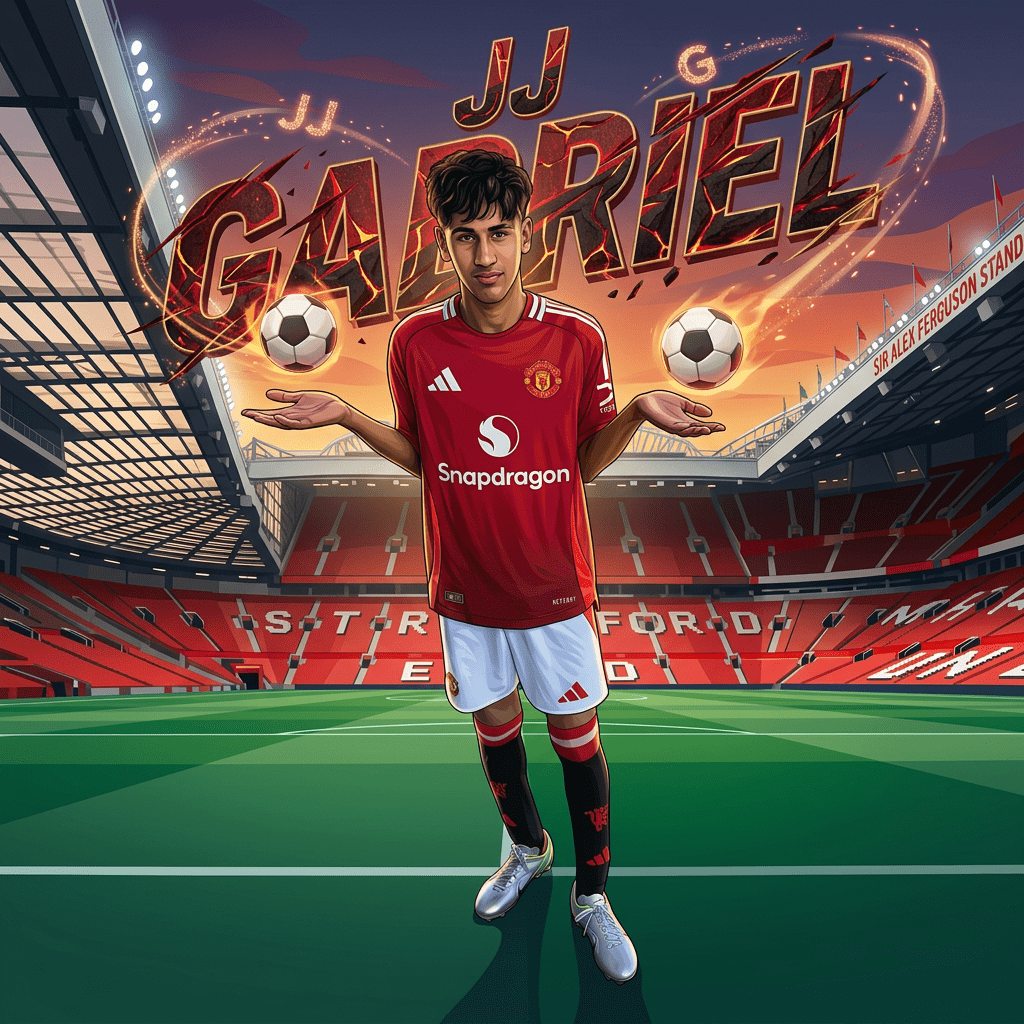
The Debut Timeline: When Gabriel Could Break Records
The calendar offers exciting options for Gabriel’s senior start. Each carries different historical weight.
The 2026-27 season starts on 22 August. Gabriel will be 15 years and 320 days old — still too young under Premier League rules. But United usually enter the EFL Cup at the third round in late September or early October. Even on the latest possible date, Gabriel would still be 15.
David Gaskell was 16 years and 19 days when he debuted as goalkeeper in 1956. If Gabriel plays in United’s EFL Cup opener, he’d smash that record by months. Duncan Edwards — the legendary Busby Babe — was 16 years, six months, and four days at his debut. Gabriel would be younger than Edwards. That carries symbolic meaning that’s hard to overstate.
He becomes eligible the moment he turns 16 in October 2026. At that point, Carrick — or whoever manages United — could pick him for Premier League duty. Angel Gomes’ record (16 years, eight months, 20 days) would need Gabriel to debut by July 2027. A spring 2027 debut during a dead-rubber game seems realistic if he keeps growing at this rate.
If United qualify for Europe, group-stage matches offer another route. Wayne Rooney sets the mental bar here — he made his Everton debut at 16 and became England’s youngest player at 17 years and 111 days. United’s ability to offer a Rooney-style path, where real first-team chances come before rivals can offer them, may decide the retention talks.
The Performance That Explains the Hype
United’s FA Youth Cup quarter-final win over Sunderland wasn’t Gabriel’s best individual show. The match secured an Old Trafford semi-final against Crystal Palace. Fletcher was careful to note this in his post-match comments. He knows that too much praise on a 15-year-old can create unhelpful pressure.
But even in a match where he didn’t peak, Gabriel showed moments that explain why United are so determined to keep him.
There was the first-time lay-off to Chido Obi in the opening half. It was a piece of technical execution that showed his spatial awareness and weight of pass. Obi should have scored. Gabriel had done everything to create the goal. Later, his perfectly weighted through-ball to Junior Brown resulted in the match-winner. That pass required Gabriel to process defensive positioning, Brown’s movement, and the exact power needed to split Sunderland’s backline. All in an instant.
Most exciting was the dazzling two-footed move late in the match. It took him into a shooting position. It’s the kind of skill that makes supporters react without thinking. That moment explains why fans wanted selfies at full-time. It explains why his name got the loudest cheer during pre-match announcements.
Youth coaches hate to single out individuals. They grasp the dangers of putting too much pressure on teenagers. But as Fletcher admitted, Gabriel exists in the same category as Arsenal’s Max Dowman — the 16-year-old who recently became the Premier League’s youngest ever scorer. For players at this level, attention is unavoidable.
The European Threat and Why United Are Right to Worry
United’s aggressive retention efforts aren’t paranoia. They’re based on harsh recent experience. The club has watched too many academy gems slip away. Jadon Sancho’s departure to Borussia Dortmund was perhaps the most painful for their City neighbours. He grew into a star there before an ironic (and failed) return to Manchester with United.
Gabriel’s London roots add complexity. Family ties to the capital mean moves to Arsenal, Chelsea, or Tottenham are more than football decisions. They’re about being close to extended family. They’re about cultural familiarity. They’re about the comfort of home. United’s north-west location has always made it harder to keep southern talents.
Continental clubs pose different threats. Barcelona and Real Madrid can promise lifestyle, prestige, and growth paths that have produced generational talents. German clubs, especially Dortmund and Bayern Munich, point to their records of bringing teenagers into first-team football earlier than English clubs do.
The money matters too. Premier League rules limit what clubs can offer youth prospects. European clubs work under different rules. They have creative ways to compensate families. United must rely on their history, superior facilities, and the promise of a real first-team pathway. Hence the Ferguson photo. Hence the directors’ box invites. Hence the former manager, Amorim’s training ground integration.
Fletcher’s comments about Gabriel’s family being “amazing” and providing “amazing support” aren’t throwaway lines. They acknowledge that retention depends partly on convincing Gabriel’s parents that United offers the best environment. The club’s academy staff stay in constant contact with families. They provide academic support, mental resources, and career guidance that goes beyond football.
The Pressure, The Promise, The Peril
Norman Whiteside remains United’s youngest ever goalscorer at 17 years and 8 days. Federico Macheda (17 years, seven months, 14 days) holds the Premier League-specific record with that unforgettable Villa Park winner. Both names serve as warnings as much as inspiration.
Whiteside’s career was cut short by injury. His body couldn’t handle the physical demands placed on it from such a young age. Macheda never recaptured his early magic. He drifted through clubs before settling in Greece. It’s a reminder that one great moment doesn’t guarantee a great career.
Gabriel’s pathway is being watched by everyone from fans to sponsors to rival clubs’ scouts. Social media boosts both praise and criticism. It creates an environment where teenage prospects face pressures that past generations never saw.
United’s challenge is giving Gabriel real chances without crushing him. That means managing expectations externally. Fletcher’s measured comments about continued growth and learning reflect this. But privately they’re speeding up his preparation for senior football.
The physical side is real. Gabriel is “much smaller than the vast majority of players he is playing with and against.” Premier League football is brutally physical. The jump from Under-18s to senior competition means facing athletes who are stronger, faster, and more experienced at managing their bodies in contact.
United’s sports science and conditioning staff are working to address this. But they can’t compromise the technical fluency that makes Gabriel special. The fear is that bulking up too quickly could reduce his agility and close control — the very things that currently set him apart.
What Happens Next
The dual Cup finals against Crystal Palace will give Gabriel more big chances. The FA Youth Cup semi-final at Old Trafford. The Premier League Under-18 Cup final at Selhurst Park. These games let him show his credentials. Old Trafford games, even at youth level, carry mental weight. Performing in the Theatre of Dreams offers a preview of what senior football might feel like.
Assume United get his signature on professional terms — he can’t sign a pro contract until turning 17. The 2026-27 season becomes crucial. That EFL Cup third-round game, likely just days after his 16th birthday, is the most likely debut scenario.
Carrick’s tactics and his past willingness to use young players will shape the timeline. If the English coach stays at United and continues the integration he’s begun, Gabriel’s path becomes clearer. Manager changes could reset everything. New coaches bring new preferences. Academy prospects can find themselves deprioritised.
The broader context of United’s season will matter too. If the first team is fighting for titles, chances for academy players shrink. Managers go back to experienced options when stakes are highest. If United are rebuilding or mid-table, youth integration often speeds up.
What’s certain is that Gabriel’s name is now known beyond United’s academy. Fans are tracking his progress. Rival clubs are watching his contract situation. The media are building narratives about the next great Old Trafford prodigy.
He’s 15 years old. Still in school. Still physically growing. Still learning his craft. But already operating where mistakes are picked apart and comparisons to club legends are made casually.
The talent is clear. The potential is extraordinary. Whether that turns into a career worthy of those Ferguson photos and directors’ box invites remains unwritten. But United are doing everything possible to make sure the story unfolds at Old Trafford rather than somewhere else.
And for fans who’ve watched too many academy gems slip away, that commitment offers real hope. These aren’t empty promises. They’re concrete actions. Gabriel might be the one who stays, develops, and delivers on the promise he’s already shown.
The countdown to his 16th birthday, and that potential record-breaking debut, has already begun.