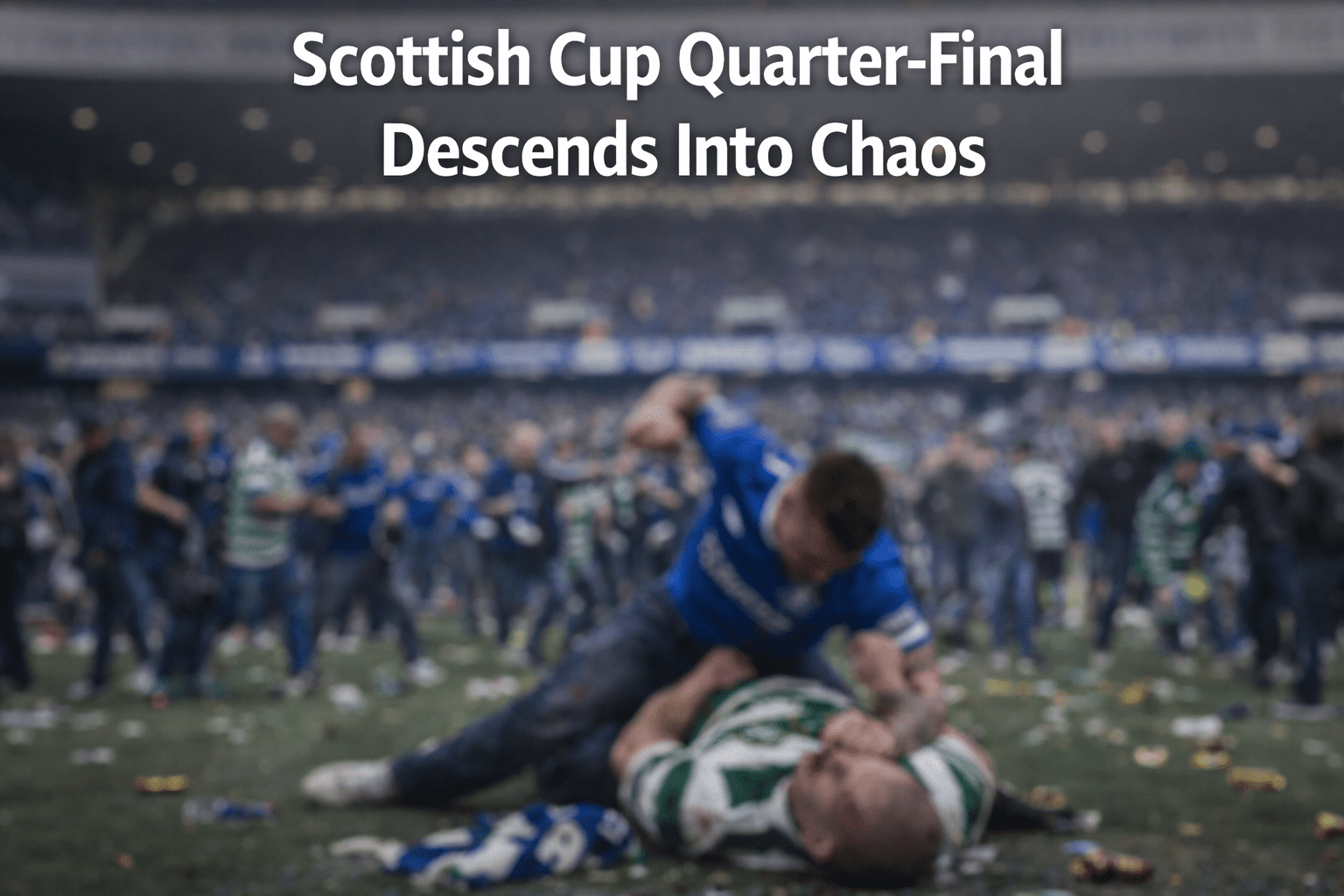
Scottish Cup Quarter-Final Descends Into Chaos: Rangers 0-0 Celtic (2-4 on Penalties)
Scottish Cup Quarter-Final Descends Into Chaos: Rangers 0-0 Celtic (2-4 on Penalties)
The 450th Old Firm meeting in league and major cups will not be remembered for the football. It will be remembered for what came after. On 08 March 2026, Celtic edged past Rangers 4-2 on penalties following a goalless 120 minutes at Ibrox to reach the Scottish Cup semi-finals — but the match was overshadowed entirely by disgraceful scenes of disorder, pitch invasions from both sets of supporters, flares hurled across the turf and a Rangers fan squaring up to Celtic full-back Julián Araujo. Police Scotland described the behaviour as “shameful” and “despicable,” confirming that arrests had been made and that officers and members of the public had been injured. The Scottish FA launched an immediate investigation. And an hour after the ground had emptied, sirens could still be heard across Govan.
Trouble Before Kick-Off
The disorder began before the first whistle had even been blown. Ticketless Celtic supporters forced entry into the Broomloan Road stand, prompting Police Scotland to close the turnstiles for a period of time and delay the security operation. The police confirmed afterwards that this pre-match breach would form part of their investigation, alongside the post-match chaos.
How the Match Unfolded — 120 Minutes of Misery
This was the fifth Old Firm meeting of the 2025-26 season, the 56th in Scottish Cup history, and the 12th at Ibrox. The occasion demanded something memorable. Instead, it delivered one of the most wretched spectacles the fixture has produced in years — a grisly battle of aerial duels, hoofball, misplaced passes, wasted free-kicks and crosses sailing harmlessly out of play.
Celtic, missing captain Callum McGregor and Kieran Tierney — both injured in the midweek win at Aberdeen — as well as Cameron Carter-Vickers (Achilles), Alistair Johnston (hamstring), Arne Engels (thigh), Jota (knee) and Kelechi Iheanacho, set up to survive rather than flourish. Martin O’Neill made five changes from the Aberdeen match, bringing in Auston Trusty (back from a league suspension), Luke McCowan, Sebastian Tounekti, Benjamin Arthur and Reo Hatate. Liam Scales took the armband and dropped to left-back as Trusty slotted into centre-half. Daizen Maeda led the line through the middle.
And survive Celtic did. They did not register a single shot on target across 120 minutes. Not one. Rangers ended the match with 24 shots to Celtic’s solitary effort. But Celtic’s defending was outstanding: firm, committed, scrambling when they had to. Trusty, in particular, was immense — blocking everything Rangers threw at him.
Rangers, by contrast, had a near-full squad available. Danny Röhl made two changes from the 2-2 league draw a week earlier, bringing in Nasser Djiga and Mohamed Diomande for John Souttar and Tochi Chukwuani — both dropped to the bench. The hosts had home advantage, a battalion of January signings and the bulk of possession. Youssef Chermiti, who had scored a brilliant double in the league match seven days prior, was kept quiet. Dujon Sterling and Chermiti looped efforts over before the break. Viljami Sinisalo came off his line sharply to foil Chermiti following a mistake by Benjamin Arthur. Andreas Skov Olsen, the marquee January loan from Club Brugge with 40 Denmark caps, was largely anonymous.
Celtic needed last-ditch blocks from Trusty and Tounekti to keep the scores blank. Röhl’s side could have played for another two hours and you still would not have backed them to score.
The Disallowed Goals
The only moments of genuine drama in open play came from goals that did not stand. Daizen Maeda thought he had given Celtic the lead 10 minutes before half-time with a diving header from McCowan’s cross, but Liam Scales was ruled offside in the build-up by VAR. More controversially, Emmanuel Fernandez wheeled away in celebration after the ball hit the back of the Celtic net 11 minutes into extra time following a corner. He saluted the fans and drank in the acclaim — but the goal was ruled out for handball, the ball having struck Fernandez’s left hand. Substitute Dane Murray’s block denied Chermiti moments later. In the closing minutes of extra time, Chermiti volleyed wide from a good chance and Sinisalo saved from Nedim Bajrami as the action continued to flow one way. Rangers ended the 120 minutes with 24 shots to Celtic’s one. It scarcely mattered.
The Penalty Shoot-Out
Rangers won the toss and chose to take the first penalty in front of the Copland Road stand. It backfired immediately.
| # | Rangers | Result | Celtic | Result | Score |
|---|---|---|---|---|---|
| 1 | James Tavernier | Crossbar | — | Scored | 0-1 |
| 2 | — | Scored | — | Scored | 1-2 |
| 3 | — | Scored | — | Scored | 2-3 |
| 4 | Djeidi Gassama | Over the Bar | Tomáš Cvancara | Scored | 2-4 |
Named penalty takers confirmed via BBC Sport and Sky Sports. The identities of the takers in rounds two and three were not individually confirmed in broadcast coverage at the time of publication.
The writing was on the wall from the moment James Tavernier, Rangers’ captain and most experienced penalty taker, struck the crossbar with the very first spot-kick. Jack Butland, who had saved eight of his previous nine penalties for Rangers, could not get near any of Celtic’s four expertly dispatched kicks. At 3-2 to Celtic, Djeidi Gassama stepped up and blazed his effort over Sinisalo’s goal. That left Tomáš Cvancara — the substitute who had entered as part of a late triple change alongside Joel Mvuka and James Forrest — to beat Butland and send Celtic through. He did, calmly and clinically, igniting the powder keg.
The Pitch Invasion — What Happened After the Final Penalty
What followed was the most disturbing sequence of events at an Old Firm match in years. It unfolded in stages:
- Stage 1 — Celtic fans invade: Supporters from the 7,500-strong Celtic contingent in the Broomloan Road end spilled on to the pitch in celebration. Celtic staff beseeched them to clear off but were ignored.
- Stage 2 — Rangers fans react: Hundreds of Rangers supporters from the Copland Road stand then invaded in response. A menacing group, many wearing masks, made a beeline for Celtic staff and players.
- Stage 3 — Confrontations: One member of Celtic’s backroom team was confronted by a Rangers fan, who was subsequently wrestled to the ground by stewards and led away by police. Then another fan — or fans — squared up to Julián Araujo, the Celtic full-back. Martin O’Neill led Araujo away. Celtic players were escorted off the pitch.
- Stage 4 — Missiles and flares: Flares were thrown from the Rangers section towards Celtic supporters. Objects came back the other way. Both sets of fans launched missiles and pyrotechnics at one another. For a moment, the threat of the two groups meeting head-on was a genuine possibility.
- Stage 5 — Police cordon: Police and stewards formed a barrier between the two groups. Order was eventually restored as the Celtic supporters were left to celebrate alone.
Chief Superintendent Kate Stephen of Police Scotland released a statement: “The behaviour of a number of supporters at the Scottish Cup quarter-final between Rangers and Celtic at Ibrox today was shameful. It must be condemned by everyone involved in football and wider society. A number of arrests have already been made, and Police Scotland will now work with both clubs and the Scottish Football Association to carry out a robust investigation following the scenes on the pitch at the conclusion of the match.”
The statement continued: “Officers and stewards were faced with extreme hostility and violence over a sustained period, with many individuals having armed themselves with items clearly intended to cause harm. Officers and members of the public have been injured in this despicable display.”
The SFA released its own statement condemning the disorder and confirming an immediate investigation in line with Judicial Panel Protocol.
What the Managers Said
Danny Röhl — Rangers
Speaking in his post-match press conference, Röhl condemned the scenes: “I was not on the pitch in the moment; I did not see it until now. I think we all know the emotional situation after a game. Nobody likes to see this. It was a great atmosphere for 120 minutes and it should be like this; the other things should not be in the stadium or in football.”
Martin O’Neill — Celtic
O’Neill expressed concern that the disorder would overshadow the result: “That would be a worry for me. The fixture itself, although still a phenomenal fixture, had lost a bit of its lustre because the away fans or the full complement of away fans were not allowed in. I have no idea what might happen. I think today, with the crowd and our crowd there, to me, it was a proper Old Firm game in that sense. We will see what develops.”
On the confrontations, O’Neill added: “It’s a big derby game and I think there was a lot of jubilation at us winning. The fans spilt over and I suppose it is very difficult to quell that. As we were making our way back, there was some kind of fracas and someone had tried to get on the field. All I saw was a bit of a scrum down at the bottom. As you say, maybe it does taint proceedings but I think there was an element of self-protection in that one.”
Charlie Adam — Former Scotland International
Charlie Adam labelled the scenes a “disgrace” on talkSPORT: “It’s a sad day for Scottish football. For the Old Firm that we talk about being our leadership teams and what they represent, it’s an embarrassment for our game. Both football clubs have to look at themselves because they are the standard-bearers for us as football clubs and they have, both supporters, let themselves down. This should not be happening. In this day and age this should not be happening and we have to get control of it quickly because if it doesn’t it’ll keep escalating and there’ll be big, big problems.”
The Away Allocation Question
Central to the post-match fallout is the decision to restore the traditional away allocation for this fixture. Between 2018 and this match, both clubs had reduced their respective away allocations from approximately 7,000 to just 800 — a move initiated by Rangers in the summer of 2018, ostensibly due to season-ticket demand, and swiftly reciprocated by Celtic.
Scottish Cup regulations, however, allow away teams to request up to 20% of the host stadium’s tickets. Celtic exercised that right for this quarter-final, resulting in 7,500 travelling supporters housed in the Broomloan Road end — the first time that scale of away support had been present at an Old Firm derby in eight years.
The experiment, in the eyes of many, has failed at the first test. The question of whether away allocations will be slashed once more is now inevitable.
Rangers 2-2 Celtic — The Old Firm Derby Seven Days Earlier
Just one week before the Scottish Cup chaos, Rangers and Celtic played out a thrilling 2-2 draw at the same venue — Youssef Chermiti’s wonder-goal double cancelled out by Kieran Tierney’s header and Reo Hatate’s dramatic stoppage-time penalty rebound. Here are the highlights from that match:
Full Team Line-Ups
| Rangers (Danny Röhl) — 4-2-2-2 | Celtic (Martin O’Neill) — 4-3-3 |
|---|---|
| Jack Butland (GK) | Viljami Sinisalo (GK) |
| Dujon Sterling (RB) | Julián Araujo (RB) |
| Nasser Djiga (CB) | Auston Trusty (CB) |
| Emmanuel Fernandez (CB) | Liam Scales (c) (LB) |
| Tuur Rommens (LB) | Benjamin Arthur (CB) |
| Nicolas Raskin (CM) | Luke McCowan (CM) |
| Mohamed Diomande (CM) | Benjamin Nygren (CM) |
| Andreas Skov Olsen (RW) | Reo Hatate (CM) |
| Mikey Moore (LW) | Sebastian Tounekti (RW) |
| Ryan Naderi (ST) | Daizen Maeda (ST) |
| Youssef Chermiti (ST) | Yang Hyun-Jun (LW) |
Substitutes
| Rangers Bench | Celtic Bench |
|---|---|
| Liam Kelly (GK) | Ross Doohan (GK) |
| John Souttar | Colby Donovan |
| James Tavernier (c) | Dane Murray |
| Jayden Meghoma | Marcelo Saracchi |
| Tochi Chukwuani | Paulo Bernardo |
| Nedim Bajrami | Alex Oxlade-Chamberlain |
| Djeidi Gassama | Joel Mvuka |
| Thelo Aasgaard | Tomáš Cvancara |
| Bojan Miovski | James Forrest |
Line-ups sourced from BBC Sport, ESPN and Sky Sports. Celtic were without Callum McGregor (hamstring, picked up at Aberdeen midweek), Kieran Tierney (injured at Aberdeen), Cameron Carter-Vickers (Achilles), Alistair Johnston (hamstring), Arne Engels (thigh), Jota (knee) and Kelechi Iheanacho. Rangers dropped John Souttar and Tochi Chukwuani to the bench, replacing them with Nasser Djiga and Mohamed Diomande. Referee: Don Robertson. VAR: Andrew Dallas.
The Wider Context — A Season of Frustration
Both clubs arrived at this fixture in an unfamiliar position: playing catch-up with Hearts, who sit top of the Scottish Premiership in a scenario neither Glasgow giant envisaged. Derek McInnes’s Hearts have defied all expectations. Rangers are third on 57 points from 29 matches; Celtic are second on 58 points. The title race is four-way, the kind of competition Scottish football has not seen in decades.
With league leaders Hearts, cup holders Aberdeen, and fellow top-six sides Motherwell and Hibernian already eliminated from the Scottish Cup, Celtic are now red-hot favourites to lift the trophy. Martin O’Neill’s side — last year’s beaten finalists — will learn their semi-final opponents from the remaining draw.
For Rangers, this defeat is devastating. They are now out of both domestic cup competitions and Europe. Their investment under Andrew Cavenagh’s ownership — knocking on for £40 million in transfer and loan fees — has yielded precious little return so far. The league title is their only remaining hope of silverware. The 1954-55 season was the last time both Rangers and Celtic failed to win a trophy in the same campaign.
2025-26 Old Firm Results This Season
| Date | Competition | Home | Score | Away |
|---|---|---|---|---|
| 31 Aug 2025 | Premiership | Rangers | 0-0 | Celtic |
| 02 Nov 2025 | League Cup SF | Celtic | 3-1 | Rangers |
| 03 Jan 2026 | Premiership | Celtic | 1-3 | Rangers |
| 01 Mar 2026 | Premiership | Rangers | 2-2 | Celtic |
| 08 Mar 2026 | Scottish Cup QF | Rangers | 0-0 (2-4p) | Celtic |
A History of Old Firm Chaos — The Matches That Shamed Scottish Football
Sunday’s scenes were shocking, but they were far from unprecedented. The Old Firm rivalry has a long and troubling history of matches descending into disorder. Here are the most notorious:
The 1909 Scottish Cup Final — The Hampden Riot
The very first Old Firm scandal of the modern era. The 1909 final ended 2-2, and the replay finished 1-1. When the crowd realised no extra time would be played — and fuelled by rumours that the results were being manipulated to boost ticket revenue — they invaded the pitch. What followed was a full-scale riot: goalposts were torn down, sections of the pitch ripped up, and the wooden pay-boxes set alight. Mounted police and the fire brigade came under attack. Over 100 people were injured. The Scottish FA withheld the trophy entirely. Neither club was awarded the cup.
The 1980 Scottish Cup Final — The Alcohol Ban Game
Celtic beat Rangers 1-0 after extra time at Hampden Park on 10 May 1980, George McCluskey scoring the winner. The final whistle triggered a mass pitch invasion from both sets of supporters. What followed was a battle involving thousands of fans and mounted police horses on the Hampden turf. The violence was so severe that it led directly to the Criminal Justice (Scotland) Act 1980, which banned the sale of alcohol at sporting events in Scotland — a law that remains in force to this day, over four decades later.
The 1987 “Shame Game” — Rangers 2-2 Celtic
On 17 October 1987, an Old Firm league match at Ibrox produced three red cards, two on-pitch fights and 62 arrests in the stands. Celtic’s Frank McAvennie and Rangers goalkeeper Chris Woods were both sent off after an altercation in the 17th minute. Terry Butcher followed later for a second bookable offence. Remarkably, Rangers rallied from 2-0 down to draw 2-2 with nine men, Ally McCoist and Richard Gough scoring. Three days later, the Procurator Fiscal ordered a police enquiry. Four players were charged with breach of the peace and taken to court. Butcher and Woods were convicted and fined; McAvennie was found not guilty; Graham Roberts’s case was found not proven.
The 1999 Title Decider — Coins, Red Cards and Hugh Dallas
Celtic 0-3 Rangers at Parkhead, 2 May 1999. The match that decided the league title descended into mayhem. Referee Hugh Dallas was struck on the forehead by a coin thrown from the crowd, blood pumping from the wound. He required stitches at half-time but returned to officiate the second half. Three players were sent off, including Celtic’s Stéphane Mahé, and 113 arrests were made. Four fans encroached on to the pitch. The SFA launched an inquiry and subsequently advised the Scottish Premier League to reconsider the use of evening kick-off times for Old Firm fixtures, recognising that a 6pm start gave supporters more time to drink before the match.
The 2011 Scottish Cup Replay — Lennon, McCoist and Diouf
Celtic 1-0 Rangers at Celtic Park, 2 March 2011. Three Rangers players were sent off — Steven Whittaker and Madjid Bougherra for two bookable offences, and El Hadji Diouf for dissent after the final whistle. Diouf had already antagonised the Celtic dugout by clashing with physio Tim Williamson as he went on to treat an injured player. At full time, Celtic manager Neil Lennon and Rangers assistant Ally McCoist squared up on the touchline and had to be physically separated. Both were subsequently charged with misconduct and handed touchline bans. The fallout was so severe that it led to a government summit at Holyrood and contributed to the Offensive Behaviour at Football and Threatening Communications (Scotland) Act 2012.
The 2016 Scottish Cup Semi-Final — Pitch Invasion at Hampden
Although not strictly an Old Firm final, Rangers’ involvement in the 2016 semi-final produced scenes eerily similar to Sunday’s. Rangers beat Celtic 5-4 on penalties after a 2-2 draw at Hampden Park. Following the shootout, thousands of fans invaded the pitch. Pockets of supporters from both sides confronted each other. Up to six Rangers players and staff were reportedly involved in altercations. The goalposts were broken and sections of turf ripped up. Mounted police were brought on to restore order. The SFA described the scenes as “appalling” and “contemptible.”
One Week Earlier — Rangers 2-2 Celtic, 1 March 2026
Even the league match seven days before this Scottish Cup tie had its share of controversy. Six men were arrested, including two 18-year-olds — one charged with assault, another with possessing a sectarian flag. A Celtic fan was later charged with breach of the peace after footage went viral of a man holding up a display reading “66” — a sickening reference to the 66 people who died in the 1971 Ibrox disaster. Rangers condemned the incident as “frustrating and upsetting.” On the pitch, pushing and shoving broke out between players at the final whistle after Hatate’s dramatic stoppage-time penalty rebound earned Celtic a 2-2 draw.
Timeline: Old Firm Controversies Through the Decades
What Happens Next?
The SFA has confirmed a formal investigation is under way in line with Judicial Panel Protocol. Police Scotland has indicated that a number of arrests have already been made, with further action expected as CCTV and mobile phone footage is reviewed. The key questions now are:
- Will away allocations be reduced again? The decision to restore 7,500 travelling fans is certain to be revisited. The experiment lasted one match.
- What happened in the tunnel? Tomáš Cvancara had blood on his jersey after the match. Rumours of a post-match confrontation between players have not been officially confirmed or denied by either club.
- What sanctions could follow? The SFA has the power to impose fines, ground closures or restrictions on both clubs. Previous incidents have led to government legislation — the 1980 riot produced the alcohol ban, the 2011 affair produced the Offensive Behaviour Act. The authorities will be watching closely.
- What about the pre-match breach? Police Scotland confirmed the investigation will also cover the actions of ticketless fans who forced entry to the Broomloan Road stand before kick-off, delaying the security operation.
Celtic’s reward for surviving Ibrox is a Scottish Cup semi-final at Hampden Park. With league leaders Hearts, cup holders Aberdeen, Motherwell and Hibernian already eliminated, O’Neill’s side are now strong favourites to lift the trophy. For Rangers, the season’s hopes rest entirely on the Premiership — a league in which they trail Hearts and Celtic from third place. Keep an eye on today’s football on TV to follow the rest of the Scottish Cup action live.
Frequently Asked Questions
What was the score in Rangers v Celtic in the Scottish Cup on 8 March 2026?
The match finished 0-0 after 120 minutes of play, including extra time. Celtic won 4-2 on penalties to reach the Scottish Cup semi-finals. Rangers’ James Tavernier hit the crossbar with the first penalty and Djeidi Gassama blazed his effort over the bar. Tomáš Cvancara scored the decisive fourth penalty for Celtic. Jack Butland could not save any of Celtic’s four spot-kicks despite having saved eight of his previous nine penalties.
What happened after the match at Ibrox?
Celtic fans from the 7,500-strong Broomloan Road contingent invaded the pitch in celebration. Hundreds of Rangers fans from the Copland Road stand then followed, with a group — many wearing masks — heading towards Celtic staff and players. A Rangers fan squared up to Celtic full-back Julián Araujo. Another was involved in an incident with a Celtic backroom staff member. Flares and missiles were thrown between the two groups. Police formed a cordon to separate them and a number of arrests were made. Officers and members of the public were injured.
Why were there 7,500 Celtic fans at Ibrox?
Scottish Cup regulations allow away teams to request up to 20% of the host stadium’s tickets. Celtic exercised this right, resulting in an allocation of approximately 7,500 in the Broomloan Road end. This was the first time the full traditional away allocation had been in place for an Old Firm derby since 2018, when both clubs cut allocations to around 800 for league matches.
Were there any disallowed goals?
Yes, two. Celtic’s Daizen Maeda had a diving header ruled out for offside in the first half — Liam Scales was judged offside by VAR after heading on Luke McCowan’s cross. In extra time, Rangers’ Emmanuel Fernandez celebrated after scoring from a corner, but the goal was disallowed for handball after the ball struck his left hand.
What did Police Scotland say about the pitch invasion?
Chief Superintendent Kate Stephen described the behaviour as “shameful” and a “despicable display.” She confirmed arrests had been made and said officers and stewards had faced “extreme hostility and violence over a sustained period, with many individuals having armed themselves with items clearly intended to cause harm.” The investigation will also cover ticketless fans who forced entry before kick-off.
Has the Old Firm had pitch invasions before?
Yes, repeatedly. The most notorious include the 1909 Hampden riot (trophy withheld after fans set fire to the ground), the 1980 Scottish Cup Final (mass brawl that led to Scotland’s alcohol ban at sporting events), the 2011 replay (Lennon-McCoist touchline brawl, government summit) and the 2016 semi-final at Hampden (pitch invasion after penalties, players assaulted, goalposts broken).
Who is leading the Scottish Premiership in 2025-26?
Hearts are the surprise leaders of the Scottish Premiership under Derek McInnes. Rangers sit third on 57 points from 29 matches and Celtic are second on 58 points. The title race is four-way, the tightest in decades. The last time both Rangers and Celtic failed to win a trophy in the same season was 1954-55.
What were the full line-ups for Rangers v Celtic on 8 March 2026?
Rangers (4-2-2-2): Butland; Sterling, Djiga, Fernandez, Rommens; Raskin, Diomande; Skov Olsen, Moore; Naderi, Chermiti. Subs: Kelly, Souttar, Tavernier, Meghoma, Chukwuani, Bajrami, Gassama, Aasgaard, Miovski. Celtic (4-3-3): Sinisalo; Araujo, Trusty, Scales (c), Arthur; McCowan, Nygren, Hatate; Tounekti, Maeda, Yang. Subs: Doohan, Donovan, Murray, Saracchi, Bernardo, Oxlade-Chamberlain, Mvuka, Cvancara, Forrest.
Last updated: 08 March 2026. Match details sourced from BBC Sport, Sky Sports, ESPN and Police Scotland. Information may be updated as further details of the SFA investigation emerge.
Article by Adrian Dane, football writer and founder of WhatChan. Adrian covers Scottish football, Premier League news, match previews and football analysis for UK fans.
Stay Across Every Old Firm Update
Whether it’s team news, fixture previews, live coverage guides or breaking news from the Scottish Cup, WhatChan keeps you informed. Bookmark WhatChan for the latest Rangers and Celtic news, Scottish football coverage and everything else you need ahead of matchday.
See Today’s Football on TV