1962-63 FA Cup · The Final
1963 FA Cup Final: Manchester United 3-1 Leicester City
The standard account of this final rests on an uncited encyclopedia article, repeats a league record that did not happen, and ignores what the newsreel cataloguers wrote down about the afternoon.
Manchester United finished nineteenth and won the FA Cup. Leicester City led the First Division in April and lost it. The whole season had spent the winter under snow.
Saturday 25 May 1963 · Wembley Stadium
What you will not find elsewhere
The referee celebrated with the winners, and then invented the red card
British Pathe's second reel from 25 May 1963 is catalogued as FILM ID 3127.14, and the cataloguer's shot list is precise about who was in the Manchester United dressing room afterwards. Denis Law goes in first. The team drink milk and champagne out of the trophy. Bobby Charlton, David Herd, Albert Quixall, John Giles, Maurice Setters, David Gaskell, Tony Dunne, Noel Cantwell, Pat Crerand, Bill Foulkes and Matt Busby are all named. And then: Referee Ken Aston comes in as well to join the victorious Manchester team. Three years later, driving away from Wembley after England played Argentina and stopping at traffic lights on Kensington High Street, the same man worked out that a yellow card and a red card would say what no language could. The official who devised football's disciplinary symbols is on film drinking with the team he had just watched win the Cup, and no history of this final mentions it.[8][4]
Leicester did not do the league double over United that season
The Wikipedia article on this final says Leicester entered it as slight favourites having done the league double over United in the process. The claim is tagged citation needed, and the same encyclopedia's table for the 1962-63 First Division contradicts it. The two clubs met on consecutive days in April: 2-2 at Old Trafford, then 4-3 to Leicester at Filbert Street. 11v11's independent season record for Manchester United gives the same two results. Leicester won one and drew one. Everything else about the favourites line holds up, and the club's own historian puts it more strongly than Wikipedia does. The double does not.[1][3][11]
One widely used FA Cup database is serving the wrong final under 1963
fa-cupfinals.co.uk has a page per final and is cited across the web. Its 1963 page is the 1962 page with the scoreline and the scorers swapped. It is headed 1962 FA Cup Final: Tottenham Hotspur vs Burnley, prints the scoreline as Tottenham Hotspur 1-3 Burnley, gives the date as Saturday 5th May 1962, the attendance as 100,000 and the referee as J Finney, and lists the Tottenham and Burnley elevens of the year before. Only the four goalscorers belong to 1963, and they are attached to the wrong clubs: Keyworth is credited to Tottenham, Law and Herd to Burnley. Checked twice, through two different fetchers and two different user agents, and against the site's own 1962 page. The other 1960s and 1970s pages we sampled are correct, so this is one broken record rather than a broken site.[19][20]
Wembley staged two finals in four days, and English football was the bigger draw
The roof went on in 1963 and the ground used it immediately. On 22 May the European Cup final was played at Wembley, where Benfica lost 2-1 to Milan in front of 45,715. On 25 May the FA Cup final was played on the same pitch in front of 99,604. The champions of Europe were decided at Wembley that week before a crowd less than half the size of the one that came back three days later for a domestic cup tie between the fourth-placed team and the nineteenth. It is the sort of thing only the two attendance figures side by side will tell you, and they are never printed side by side.[6][1][10]
United won the Cup in eighty-two days. Leicester took a hundred and thirty-seven to lose it
The RSSSF record of the 1962-63 competition dates every tie as it was actually played, and the two finalists had wildly different winters. Leicester got their third round in on 8 January, four days late. Manchester United could not play theirs until 4 March, fifty-eight days after the scheduled date, by which time Leicester had already played two rounds. From their first tie to the trophy, United's cup run lasted eighty-two days; Leicester's lasted a hundred and thirty-seven. The competition as a whole ran from 3 November to 25 May, two hundred and three days, and the winners were in it for barely a third of that.[12][2]
Leicester changed their shirts for the benefit of television
Leicester did not play in blue, and the reason belongs to the era rather than to superstition. Their own club historian explains: Leicester wore an all-white strip in the 1963 FA Cup Final because black and white television coverage meant that their blue shirts would have been indistinguishable from Manchester United's red shirts on the nation's TV screens.
Television shaped what the players wore before it shaped anything else about the day.[15]
The first trophy after Munich
This was not simply another cup win for Manchester United. The club's own trophy room records what it meant: The FA Cup final in 1963 provided United's first silverware after Munich
Five years had passed since the crash.[16]
Leicester came to Wembley as the Ice Kings
The winter that season froze English football almost solid, and Leicester played through it better than anyone: The harsh winter conditions that year gave rise to the team's 'Ice Kings' nickname.
The backlog it created is why their run to the final took so much longer than United's.[15]
The footage
The match report
The 1962-63 FA Cup was buried by the Big Freeze. The third round was due on the first Saturday in January; a handful of ties went ahead and the rest disappeared, some of them postponed ten times or more, and the round was not completed until well into March. A body called the Pools Panel was invented to guess the results of matches nobody could play. Manchester United went from Boxing Day to late February without completing a league fixture. The Football League pushed its season back by four weeks from the original late-April finish, and the FA moved the final from 4 May to 25 May. It was the first FA Cup final ever to be rescheduled.[1][2][18][12]
The thaw left the two finalists going in opposite directions. Leicester City had been the story of the season: unbeaten in sixteen league and cup matches, ten of them won in succession, top of the First Division with five games to go, and nicknamed the Ice Kings for winning on frozen pitches while the rest of the country sat idle. Manchester United had spent the spring fighting relegation. They played eleven league matches in the five weeks before Wembley, lost four of their last seven, and finished nineteenth of twenty-two on 34 points, three clear of a Manchester City side that went down. Leicester were clear favourites. They also finished fourth rather than first, which is the part of the story their own club historian tells and most match reports do not.[15][3][2][11]
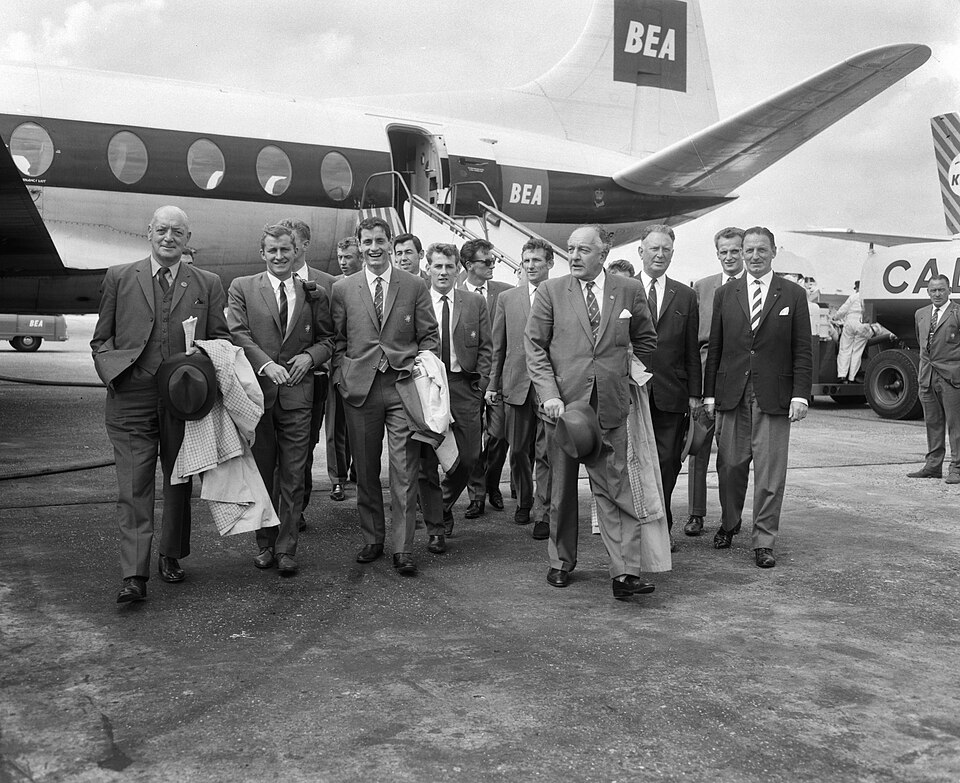
Wembley itself was in its first season with a lid on. The all-encircling roof of aluminium and translucent glass went up in 1963, along with an electric scoreboard, as part of the work that would carry the ground to the World Cup three years later. The stadium had already used both: the European Cup final was played there on 22 May, three days before this match, and Benfica lost it to Milan in front of 45,715 people. The FA Cup final drew 99,604, more than twice as many. Because the BBC were showing the match live in black and white, Leicester changed out of blue into an all-white strip so that viewers could tell the two sides apart.[5][6][1][15]
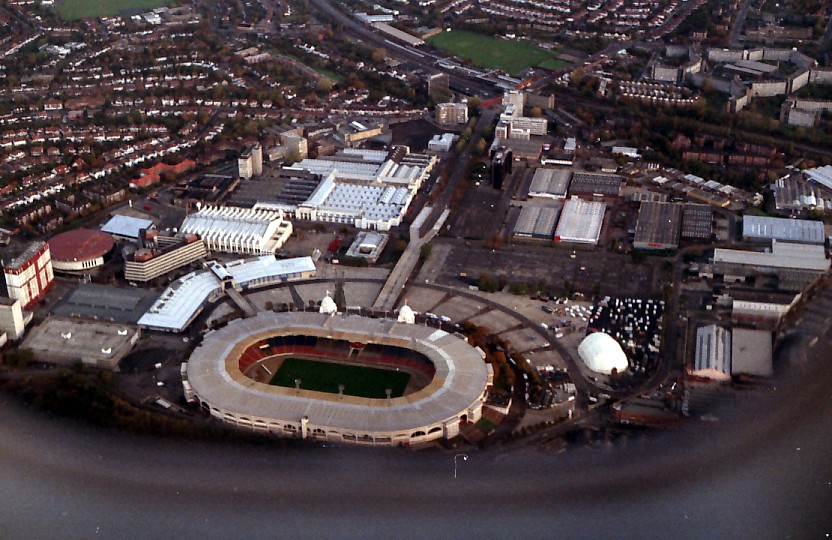
British Pathe filmed the afternoon in Technicolor, and its cataloguer wrote down what the camera saw. The band of the Royal Marines in front of the rostrum, Frank Rex standing on it to lead the community singing, the crowd singing back. The two managers walking their teams out, Matt Gillies on the left and Matt Busby on the right. Then the captains in the middle with the referee: Colin Appleton spins the coin, and Noel Cantwell calls it wrong. Leicester won the toss and lost everything else.[7]
Leicester started the better. Mike Stringfellow got past his man and crossed, and David Gaskell in the United goal could only touch the ball across his own six-yard box and behind. Soon afterwards Maurice Setters headed back towards his own goal, Stringfellow chased it, and Gaskell punched clear as the two of them collided. Then United took hold of the match and did not let go. On 30 minutes Gordon Banks saved comfortably from Bobby Charlton and threw the ball out to Dave Gibson; Pat Crerand read it, took the ball around twenty-five yards from the Leicester goal and gave it to Denis Law, who turned in one movement and shot past Banks. Law should have had a second before half-time and could not steer it in.[7][1][10]
Leicester came out for the second half with intent and were given another chance by Gaskell, who dropped the ball at Graham Cross's feet. Nothing came of it. On 57 minutes Johnny Giles swung the ball across the field to Charlton, who ran in on goal and shot; Banks got something on it but could not hold it, and David Herd pushed the rebound over the line. Leicester finally scored on 80 minutes, when Frank McLintock let fly from distance and Ken Keyworth threw himself at it and headed it in. It changed nothing. On 85 minutes Banks came for a Giles cross, fumbled it, and Herd turned and drove the ball past two defenders standing on the goal line.[1][7][18][10]
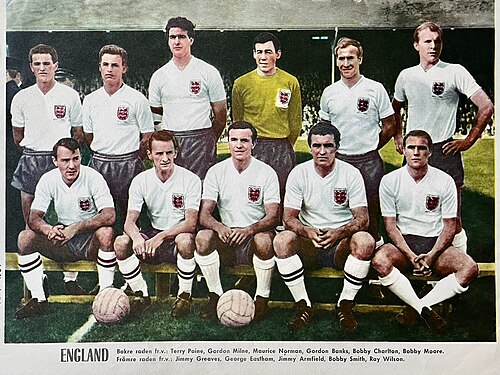
Queen Elizabeth II presented the trophy to Cantwell. For Manchester United it was the first silverware since the Munich air disaster and the first major trophy for six years, won in the first season of a forward line built around Denis Law, bought from Torino the previous summer for a British record fee. It also sent United into the European Cup Winners' Cup from nineteenth place in the league. For Leicester City it was a third FA Cup final and a third defeat, and the end of the only season in which they have gone to Wembley as favourites.[16][17][3][1]
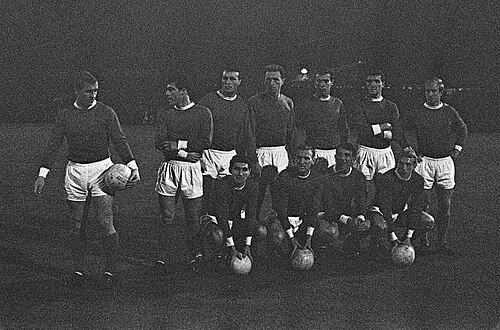
What happened next is the part the football histories leave out, and it survives only because an archivist typed it into a catalogue. Pathe's second reel follows the winners down the tunnel. Law is first into the dressing room; the team drink milk and champagne out of the FA Cup; and then, the cataloguer notes, the referee comes in to join them. The referee was Ken Aston, who had taken charge of the Battle of Santiago at the World Cup the year before, and who three years later, driving home from Wembley and stopping at a set of traffic lights, would work out the yellow and red card.[8][4]
How the match unfolded
- before kick-offThe band of the Royal Marines plays in front of the rostrum while Frank Rex leads the community singing, and the newsreel cameras pan across a full stadium.[7]
- the tossThe captains meet referee Aston in the centre circle. Colin Appleton spins the coin and Noel Cantwell calls it wrong.[7]
- first halfLeicester have the better of the opening. Mike Stringfellow crosses, David Gaskell gets a foot to it and the ball runs across the face of goal and behind. Later Maurice Setters heads back towards his own goal and Gaskell has to punch clear with Stringfellow on top of him.[7][1]
- 30'Gordon Banks saves from Bobby Charlton and throws the ball out to Dave Gibson. Pat Crerand reads it, intercepts around twenty-five yards from goal and feeds Denis Law, who turns and shoots past the diving Banks.[1][7][10]
- half-timeLeicester City 0 Manchester United 1. The band wheels and counter-marches while the Queen and the Duke of Edinburgh watch from the royal box.[7]
- 57'Johnny Giles switches the ball across the field to Charlton, who runs in and shoots. Banks cannot hold it and David Herd puts the rebound over the line.[1][7][10]
- 80'Frank McLintock shoots hopefully from distance and Ken Keyworth meets it with a diving header. The new electric scoreboard reads Leicester City 1, Manchester United 2.[1][18][7]
- 85'Banks comes for another Giles cross and fumbles it into Herd's path. Herd turns and finishes past two defenders standing on the goal line.[1][18][10]
- full-timeManchester United win 3-1. Queen Elizabeth II presents the trophy to Noel Cantwell.[1][8][12]
- after the matchBritish Pathe's cameras follow the winners into the dressing room, where the team drink milk and champagne out of the trophy and referee Aston comes in to join them.[8]
Match facts
- Date
- Saturday 25 May 1963
- Venue
- Wembley Stadium, London
- Attendance
- 99,604The figure printed by the match records. Wikipedia's own page for Manchester United's 1962-63 season rounds it to a flat 100,000, which is the number to treat with suspicion rather than this one.[1][10][13]
- Half-time
- 1-0
- Competition
- 1962-63 FA Cup
Where they played
Both sides as they lined up. Choose any player to read what they did in this final.
Select a shirt for that player's note.
Route to the final
Leicester City
- Third round: Grimsby Town (a) won 3-1
- Fourth round: Ipswich Town (h) won 3-1
- Fifth round: Leyton Orient (a) won 1-0
- Sixth round: Norwich City (a) won 2-0
- Semi-final: Liverpool (Hillsborough) won 1-0
Manchester United
- Third round: Huddersfield Town (h) won 5-0
- Fourth round: Aston Villa (h) won 1-0
- Fifth round: Chelsea (h) won 2-1
- Sixth round: Coventry City (a) won 3-1
- Semi-final: Southampton (Villa Park) won 1-0
Line-ups
Leicester City · 2-3-5
- Gordon Banks Goalkeeper; England's first-choice goalkeeper within a year and a World Cup winner in 1966
- John Sjoberg Right back
- Richie Norman Left back
- Frank McLintock Right half; his shot was turned in for Leicester's goal, and he captained Arsenal to the double eight years later
- Ian King Centre half
- Colin Appleton Left half and captain; spun the coin at the toss
- Howard Riley Outside right; wore the white change shirt now held by the club
- Graham Cross Inside right
- Ken Keyworth Centre forward; scored Leicester's goal
- Dave Gibson Inside left
- Mike Stringfellow Outside left; made Leicester's best early chance
Manchester United · 2-3-5
- David Gaskell Goalkeeper; uncertain early on, then untroubled
- Tony Dunne Right back
- Noel Cantwell Left back and captain; called the toss wrong and lifted the trophy
- Pat Crerand Right half, usually called Paddy; won the ball back for the opening goal
- Bill Foulkes Centre half; a survivor of the Munich air disaster
- Maurice Setters Left half
- Johnny Giles Outside right; made the second and third goals
- Albert Quixall Inside right
- David Herd Centre forward; scored twice
- Denis Law Inside left; opened the scoring in his first season at the club
- Bobby Charlton Outside left; a survivor of the Munich air disaster, and his shot led to the second goal
Trivia and detail
- The third round was due on 5 January 1963. A few ties were played that day, some were postponed ten times or more, and the round was not completed until 11 March.[1][2][12]
- Wembley staged the European Cup final on 22 May 1963, three days before this match. Benfica lost 2-1 to Milan in front of 45,715, fewer than half the crowd that came back for the FA Cup final.[6][1]
- Denis Law had joined Manchester United from Torino the previous summer for a British record fee of 115,000 pounds. This was his first season at the club.[17][2]
- Manchester United entered the European Cup Winners' Cup as FA Cup holders from nineteenth place in the First Division, one place and one point above the relegation zone.[3][2]
- Ken Aston had refereed the Battle of Santiago between Chile and Italy at the 1962 World Cup. He devised the yellow and red card system after the 1966 World Cup, at traffic lights on Kensington High Street on the drive from Wembley to Lancaster Gate.[4]
- Wembley's all-encircling roof of aluminium and translucent glass and its electric scoreboard were both installed in 1963. British Pathe's cameras filmed the new board reading Leicester City 1, Manchester United 2.[5][7]
- Leicester City had now reached three FA Cup finals, in 1949, 1961 and 1963, and lost all three.[1][18]
- The white shirt Howard Riley wore in this final is kept by Leicester City. The design, without the Wembley 1963 scroll under the crest, had been introduced as the away shirt midway through the same season.[15]
How well do you know the 1963 final?
Five questions. Every answer is sourced from the material on this page.
-
Why was the 1963 FA Cup final played as late as 25 May?
-
Where did Manchester United finish in the First Division in the season they won this Cup?
-
Who scored twice for Manchester United in the final?
-
Why did Leicester City play the final in an all-white strip?
-
The referee of this final later gave football one of its most familiar inventions. What was it?
What is not settled
Honesty matters more than tidiness. These details are contested or unrecorded, and we have not guessed at them:
- The formations shown here are a notation, not an observation. No source consulted prints a shape for either side, so the pitch draws the positional labels the standard line-up record assigns, which makes both teams 2-3-5. Those labels are the numbered convention of the period rather than a description of where eleven men actually stood in 1963.
- The goal minutes are not agreed. Wikipedia, 11v11 and mufcinfo's match record give 30, 57, 80 and 85. mufcinfo's own line-up page for the same match gives 56 for Herd's first goal and 84 for Keyworth's. The figures carried in the data here are the ones three sources share.
- Ken Keyworth's goal is described as a diving header by Historical Football Kits and by Wikipedia, and as a shot by the British Pathe cataloguer who watched the film. The header is better supported and is what the record says.
- The referee's association is given as Ilford by Wikipedia and as Colchester by mufcinfo. Aston was born in Colchester and was head teacher of a school in Ilford from 1953 until after this final, which is most likely how both got into circulation.
- The attendance is given as 99,604 by the match records and rounded to a flat 100,000 by Wikipedia's page for Manchester United's 1962-63 season.
- No source consulted records the kick-off time, so none is claimed.
- Almost every sentence of the match narrative in the Wikipedia article on this final is tagged citation needed. Where this page could replace that narrative with the British Pathe cataloguer's shot list, it has.
- British Pathe's reel of crowds arriving at Wembley is catalogued as unissued material that the archive itself only says probably comes from this match, so it is treated here as context rather than as a record of the day.
How we know
Every claim on this page is tied to a numbered source below. These are the contemporary records behind it, each one fetched and matched word for word before publication rather than taken on trust:
- Cataloguer's shot-by-shot synopsis of the colour newsreel of the final, from the community singing to Leicester's goal · British Pathe (official YouTube catalogue)
- Cataloguer's synopsis of the dressing-room and royal-box material shot on the day · British Pathe (official YouTube catalogue)
- Unissued material; the archive's own record dates it to around 25 May 1963 and is not certain of it · British Pathe (official YouTube catalogue)
Where a primary record and a modern account disagree, we show both rather than choosing the tidier number.
Sources
- 1963 FA Cup final · Wikipedia
- 1962-63 Manchester United F.C. season · Wikipedia
- 1962-63 Football League First Division · Wikipedia
- Ken Aston · Wikipedia
- Wembley Stadium (1923) · Wikipedia
- 1963 European Cup final · Wikipedia
- The Cup Final - Technicolor (1963), FILM ID 1762.17 (archive film and catalogue synopsis) · British Pathe (official YouTube catalogue)
- Wembley Cup Final Scenes - Man Utd Beat Leicester (1963), FILM ID 3127.14 (archive film and catalogue synopsis) · British Pathe (official YouTube catalogue)
- Cup Final Crowds Arriving At Wembley (1963), FILM ID 3133.05 (unissued material, archive catalogue synopsis) · British Pathe (official YouTube catalogue)
- Manchester United v Leicester City, 25 May 1963 · 11v11 (AFS Enterprises)
- Manchester United match record: 1962-63 · 11v11 (AFS Enterprises)
- England - FA Challenge Cup 1962-1963 · Rec.Sport.Soccer Statistics Foundation
- Manchester United 3 v 1 Leicester City, FA Cup Final, 25 May 1963 (match record) · mufcinfo.com
- 1963 FA Cup Final line up - Leicester City 1 v 3 Manchester United · mufcinfo.com
- The Story Of Our 1963 FA Cup Final Shirt · Leicester City FC, by club historian John Hutchinson
- FA Cup - Manchester United trophy room · Manchester United FC
- 1960-1969 - Manchester United history by decade · Manchester United FC
- The FA Cup Finalists 1960-1969 · Historical Football Kits
- 1963 FA Cup Final (page as published) · FA Cup Finals (fa-cupfinals.co.uk)
- 1962 FA Cup Final: Tottenham Hotspur vs Burnley · FA Cup Finals (fa-cupfinals.co.uk)