1964-65 FA Cup · The Final
1965 FA Cup Final: Liverpool 2-1 Leeds United
The most-read account of this final times the winning goal six minutes later than the three fullest match reports do, and the surviving newsreel catalogue puts the Leeds captain in the Liverpool team. This page sets the records side by side instead of picking the tidiest one.
Liverpool won the FA Cup at the seventy-third attempt, in a final nobody enjoyed, with a left back who had broken his collarbone in the opening minutes and could not be replaced.
Saturday 1 May 1965 · Wembley Stadium
What you will not find elsewhere
Four sources, three different minutes for the winning goal
The most widely read account of this final, the Wikipedia article, times Ian St John's winner at the 117th minute. It is the outlier. LFCHistory's match archive, Play Up Liverpool's contemporary summary and the Definitive History of Leeds United all put it at the 111th, and the Leeds account describes it as arriving six minutes into the second period of extra time, which is the same thing said a different way. 11v11 has 113. Billy Bremner's equaliser is no better: 100 in two places, 101 in a third, 102 in a fourth, and a narrative that implies 99. The only goal in this match that everybody times identically is Roger Hunt's, at 93 minutes. We publish 93, 100 and 111 and show the disagreement rather than hiding it.[1][4][6][7][5]
The newsreel catalogue puts the Leeds captain in the Liverpool team
The catalogue text attached to British Pathe's surviving colour film of this final, the record a search engine actually indexes, states that Collins of Liverpool fouls Byrne and then lists Collins among the Liverpool team while placing Byrne and Hunter among the Leeds players. Bobby Collins captained Leeds United; Gerry Byrne and Norman Hunter were on opposite sides of that collision, Byrne for Liverpool and Hunter for Leeds. Every team sheet consulted agrees. The film is the real thing and worth watching; its index card is wrong.[9][1][3][4]
Liverpool won the Cup without ever scoring three
Counted straight off the round-by-round results, replays included, Liverpool played eight matches to win the 1965 FA Cup, scored eleven goals and conceded three. They never scored more than two in any tie, and the final was one of four ties they won by exactly two. Leeds scored more on the way, thirteen in the same number of matches, and lost the one that counted.[2][3][1]
This final did not bring in substitutes, and the FA Cup was last to adopt them
Gerry Byrne playing two hours with a broken collarbone is regularly offered as the case that changed the rule. The sequence does not support it. The Football League had already decided to permit one substitute for an injured player from the start of 1965-66, and Keith Peacock of Charlton Athletic came on at Bolton on 21 August 1965. The FA Cup did not allow substitutes until 1966-67. So the competition in which Byrne was hurt staged one more entirely substitute-free final, in 1966, after the League had already moved.[15][1][16]
Liverpool's left back played almost the whole final with a broken collarbone
No substitutes were permitted, so leaving the field meant leaving his side a man short. Gerry Byrne stayed on, and his own account is remarkably flat about it: I'd never broken a collarbone before, so I wasn't aware of what damage had been done straight away.
He played on through extra time and set up the opening goal.[7]
The first Black player to appear in an FA Cup final, and what he heard from the terraces
Albert Johanneson's presence in the Leeds side made this final a landmark, and the record should not stop at the landmark. In his own words, the afternoon sounded like this: all I could hear was a cacophony of Zulu-like noises coming from the terraces
The abuse is part of the history of this final and is recorded here for that reason.[14]
Shankly's measure of a season most managers would take
Liverpool had finished second in the league and won the Cup, and their manager was not inclined to call that a disappointment: Second in the championship; FA Cup finalists; ninety per cent of the managers in the English League pray every night for
The sentence is a useful corrective to how the era is usually remembered.[7]
The footage
The match report
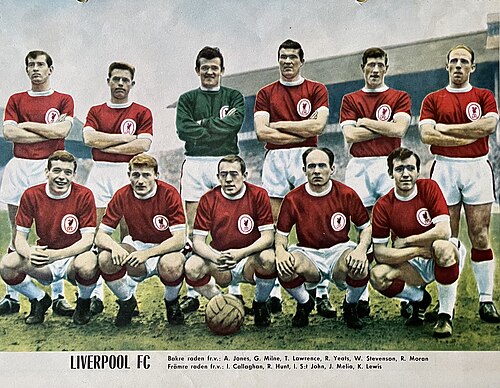
Liverpool came to Wembley as the reigning champions of England with an obvious hole in the trophy room. They had reached the FA Cup final twice, in 1914 and in 1950, and had lost both. Leeds United had never reached one at all. Don Revie's side were in their first season back in the First Division, and days earlier they had finished runners-up in the league on goal average, so they arrived in London having just lost one trophy and about to play for another. Whichever way the afternoon went, a new name was going on the cup.[1][7][4]
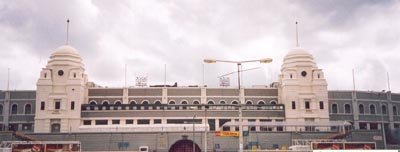
Neither route had been spectacular. Liverpool needed replays to get past Stockport County and Leicester City, never scored more than two goals in any tie, and reached the final with eleven goals from eight matches and three conceded. Their hardest test was the semi-final against Chelsea at Villa Park, before which Bill Shankly is said to have found a brochure printed for a Chelsea final and pinned it up in his own dressing room. Leeds drew Southport, Shrewsbury Town and Crystal Palace out of the lower divisions but needed replays to see off Everton and then Manchester United, the second of them in a semi-final at Hillsborough that contemporary reporting described as a shambles and that Bremner settled with a header in the closing minute. Liverpool lost Gordon Milne to a knee injury in the days beforehand and gave his place to Geoff Strong.[1][2][7]
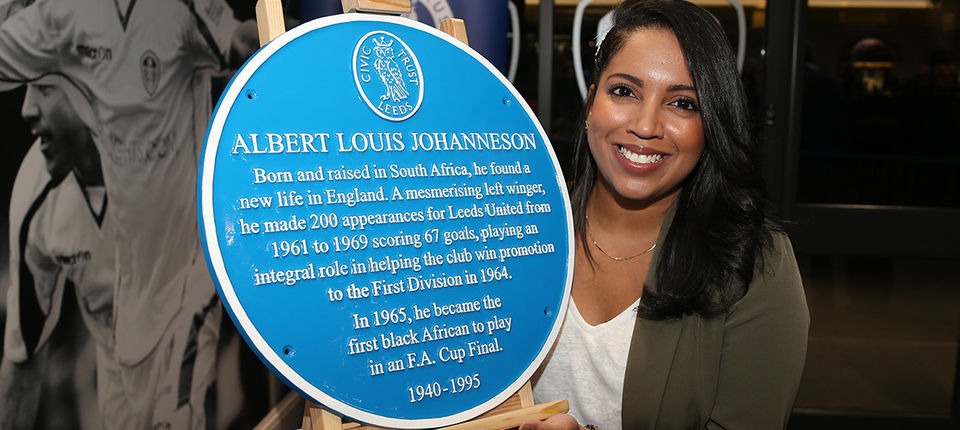
Leeds' left winger Albert Johanneson became the first Black player to appear in an FA Cup final, and the day was ruined for him before it started. He spent much of the build-up being sick, asked Revie to leave him out, and was told in the tunnel that he had no chance looking the way he did and that the crowd would murder him. He had a poor match and it is widely treated as the turning point of his career. Fifty years later The FA, the PFA and the Football Unites, Racism Divides project marked the anniversary and his family presented his runners-up medal to the National Football Museum; Leeds United's own account of him records the same first, and a Leeds Civic Trust plaque went up at Elland Road in 2019.[14][12][17]
Inside the opening minutes Gerry Byrne went into a challenge with Bobby Collins and broke his collarbone. English football allowed no substitutes at all in 1964-65, so walking off would have left Liverpool a man short for the rest of the afternoon. Byrne did not realise what he had done, and Shankly decided not to tell him. He played the whole match, extra time included, with the arm hanging at his side, and he was still the player who made the opening goal.[1][16][13]
What followed was not a good football match. Rain arrived after twenty-five minutes and the two most systematic sides in England cancelled each other out. Liverpool had much the better of it. Roger Hunt and Ian St John pulled Jack Charlton and Norman Hunter around, Peter Thompson ran at the full backs, and Gary Sprake in the Leeds goal had the game of his life. Leeds, with Jim Storrie hobbling and Johanneson out of the game, managed almost nothing. Ninety minutes ended goalless and the final went to extra time for the first time since 1947.[7][1][3]
It took three minutes of the extra half hour to break the deadlock. Willie Stevenson slid a pass to Byrne on the overlap, the full back with the broken collarbone reached the byline, and his cross was headed in by Hunt in the 93rd minute. Leeds levelled almost at once, Hunter's long ball nodded down by Charlton and volleyed past Tommy Lawrence by Bremner. In the second period Thompson found Tommy Smith, Smith found Ian Callaghan on the right, Callaghan beat Willie Bell to the byline, and St John threw himself at the cross to head the winner in the 111th minute.[4][7][6]
The press verdict was harsh. Ken Jones in the Daily Mirror wrote that tiredness had destroyed the discipline and that behind the boredom lay the failure of players like Johanneson and Thompson to lift it. The Times was kinder, calling it a tense battle of human qualities in which a quiet opening half set up a pulsating finish. Charlton's own complaint afterwards was not that Leeds had lost but that they had lost dully, which he thought was out of keeping with what the side could do.[1][7]
Ron Yeats collected the trophy from Queen Elizabeth II. The newsreel cameras found Prince Philip, Harold Wilson, James Callaghan and Field Marshal Montgomery in the royal box, and the Kop singing the song that gave the afternoon its only agreed line. Something close to half a million people met the team when it got home. Three days after that, Liverpool played Inter Milan at Anfield in the semi-final of the European Cup, paraded the cup before kick-off and won 3-1, then lost the second leg in Milan and went out.[9][10][1]
This final is often produced as the argument that finally brought substitutes into English football, and the timing does not quite support the claim. The Football League had already decided to allow one substitute for an injured player from the start of 1965-66, and Keith Peacock of Charlton Athletic came on at Bolton that August. The FA Cup itself did not follow until 1966-67. The competition that had just watched a man play two hours with a broken collarbone therefore staged one more substitute-free final, in 1966, before anything changed.[15][1][16]
How the match unfolded
- 15:00Kick-off. Bobby Collins wins the toss and elects to change ends, so Liverpool kick off.[7][1]
- first five minutesGerry Byrne and Bobby Collins collide. Byrne breaks his collarbone and stays on, because no substitute of any kind is allowed. Norman Hunter is hurt in the same passage of play.[1][7][16]
- 25'Heavy rain begins to fall.[7]
- half-timeGoalless. The Royal Marines band takes the pitch.[9][7]
- full-timeStill goalless after ninety minutes. The final goes to extra time for the first time since 1947.[1][3][7]
- 93'Willie Stevenson releases Byrne on the overlap and his cross from the byline is headed in by Roger Hunt.[4][7][3]
- 100'Hunter's long ball is headed down by Jack Charlton and Billy Bremner volleys past Tommy Lawrence to level it.[1][5][7]
- 111'Tommy Smith finds Ian Callaghan, who beats Willie Bell to the byline, and Ian St John dives to head the winner.[4][6][7]
- after the matchRon Yeats collects the trophy from Queen Elizabeth II and Liverpool take a lap of honour.[9][1]
Match facts
Where they played
Both sides as they lined up. Choose any player to read what they did in this final.
Select a shirt for that player's note.
Route to the final
Liverpool
- Round 3: West Bromwich Albion (a) won 2-1
- Round 4: Stockport County (h) drew 1-1, replay (a) won 2-0
- Round 5: Bolton Wanderers (a) won 1-0
- Round 6: Leicester City (a) drew 0-0, replay (h) won 1-0
- Semi-final: Chelsea (Villa Park) won 2-0
Leeds United
- Round 3: Southport (h) won 3-0
- Round 4: Everton (h) drew 1-1, replay (a) won 2-1
- Round 5: Shrewsbury Town (h) won 2-0
- Round 6: Crystal Palace (a) won 3-0
- Semi-final: Manchester United (Hillsborough) drew 0-0, replay (City Ground) won 1-0
Line-ups
Liverpool · 4-4-2
- Tommy Lawrence Goalkeeper
- Chris Lawler Right back, in his first season as a first-choice full back
- Tommy Smith Centre back, sweeping up while wearing the number 10 shirt
- Ron Yeats Centre half and captain, who collected the trophy
- Gerry Byrne Left back, who broke his collarbone in the opening minutes and played on to the end of extra time
- Ian Callaghan Right side, crossed for the winning goal
- Geoff Strong Midfield, in the side because Gordon Milne was injured
- Willie Stevenson Midfield, released Byrne for the opening goal
- Peter Thompson Left side
- Roger Hunt Forward, headed the opening goal in the 93rd minute
- Ian St John Forward, headed the winner in the 111th minute
Leeds United · 4-4-2
- Gary Sprake Goalkeeper, widely rated the outstanding player on the day
- Paul Reaney Right back
- Jack Charlton Centre half, headed down the ball for the equaliser
- Norman Hunter Centre back, hurt in the same early collision that broke Byrne's collarbone
- Willie Bell Left back
- Johnny Giles Right side
- Billy Bremner Midfield, scored Leeds' goal and was pushed forward as the match wore on
- Bobby Collins Midfield and captain, the reigning Footballer of the Year
- Albert Johanneson Left wing, the first Black player to appear in an FA Cup final
- Jim Storrie Forward, hampered by an ankle injury and moved out to the right
- Alan Peacock Centre forward
Trivia and detail
- Gordon Milne missed the final with a knee injury. His father Jimmy Milne had missed Preston North End's 1938 final after breaking a collarbone shortly before it, in a collision with Arsenal's Alf Kirchen.[18][7]
- Tommy Smith played the final at centre back while wearing the number 10 shirt, in an era when shirt numbers were still expected to describe positions.[7][1]
- Bobby Collins refused the new white socks the rest of the Leeds side wore and played in the yellowing woollen pair he had worn all season. He recalled that the Duke of Edinburgh noticed them and mentioned it when the teams were presented.[7]
- The Movietone rushes held under story 89649 show Harold Wilson, James Callaghan and Field Marshal Montgomery in the royal box alongside the Queen and Prince Philip.[10]
- Bobby Collins captained Leeds as the reigning Footballer of the Year, the first Leeds United player to win the award.[7][17]
- Jack Charlton reckoned that only he and Collins had played at Wembley before, and that his own experience amounted to one England appearance a few months earlier.[7]
- Albert Johanneson's runners-up medal was presented to the National Football Museum in Manchester by his daughter and granddaughters in May 2015, fifty years after the final.[12]
How well do you know the 1965 final?
Five questions. Every answer is sourced from the material on this page.
-
What did Gerry Byrne do in the opening minutes and play on with?
-
Who became the first Black player to appear in an FA Cup final?
-
Why did this final go to extra time for the first time since 1947?
-
Which goal in this final is timed identically by every source?
-
How many goals did Liverpool score in the whole of their 1965 cup run?
What is not settled
Honesty matters more than tidiness. These details are contested or unrecorded, and we have not guessed at them:
- The minute of Ian St John's winning goal is not settled. LFCHistory, Play Up Liverpool and the Definitive History of Leeds United all place it in the 111th minute, six minutes into the second period of extra time; 11v11 says the 113th; Wikipedia says the 117th. This page follows 111, the figure three independent accounts share.
- The minute of Billy Bremner's equaliser is not settled either. Wikipedia and 11v11 both say the 100th minute, Play Up Liverpool says the 101st, LFCHistory says the 102nd, and the Definitive History of Leeds United describes it as coming after nine minutes of extra time, which would be the 99th. This page follows 100, which two independent sources give.
- Only Roger Hunt's goal is timed identically everywhere, at 93 minutes.
- Accounts differ on when Gerry Byrne broke his collarbone. Wikipedia puts the collision five minutes in; the Definitive History of Leeds United puts it in the third minute, immediately after Norman Hunter hurt his ankle. The timeline here says only that it happened in the first five minutes.
- Wikipedia records both sides as 4-4-2 and that is the shape drawn here. The Definitive History of Leeds United describes Liverpool as alternating between 4-4-2 and 4-2-4 through the match. Play Up Liverpool lists both teams as 2-3-5, which reflects the shirt-number convention of the period rather than where the players actually stood.
- The archived fa-cupfinals.co.uk page prints Callaghan as Callagher and Bremner as Bremener, and lists the two elevens in shirt-number order rather than by position. These are transcription artefacts, not a different team.
- No source consulted publishes a turnstile figure for this final. Every one of them gives 100,000, which is the stated Wembley capacity of the period.
- The Definitive History of Leeds United says Jimmy Milne broke his collarbone a fortnight before the 1938 final; Spartacus Educational says a week. The trivia entry here says only that it was shortly before.
How we know
Every claim on this page is tied to a numbered source below. These are the contemporary records behind it, each one fetched and matched word for word before publication rather than taken on trust:
- The Cup Final - Liverpool Vs. Leeds 1965 (1965), FILM ID 1796.22 (archive film and catalogue synopsis) · British Pathe (official YouTube catalogue)
- HOW THEY WON AT WEMBLEY (THE CUP FINAL 1965), story 89649 rushes (archive film and catalogue synopsis) · British Movietone / AP Archive (official YouTube catalogue)
- HOW THEY WON AT WEMBLEY (THE CUP FINAL 1965) - COLOUR (archive film and catalogue synopsis) · British Movietone / AP Archive (official YouTube catalogue)
- Football remembers Albert Johanneson with special presentation in Manchester · The Football Association
- FA extremely saddened by the death of Gerry Byrne · The Football Association
Where a primary record and a modern account disagree, we show both rather than choosing the tidier number.
Sources
- 1965 FA Cup final · Wikipedia
- England - FA Challenge Cup 1964-1965, round by round · Rec.Sport.Soccer Statistics Foundation
- FA Cup Final 1965 (archived match report and round-by-round results) · fa-cupfinals.co.uk, via the Internet Archive
- Liverpool 2-1 Leeds United, FA Cup Final, 1 May 1965 (match archive) · LFCHistory.net
- Leeds United v Liverpool, 01 May 1965 (match record) · AFS Enterprises / 11v11
- Liverpool v Leeds United 2-1 (FA Cup Final: May 1, 1965) · Play Up, Liverpool
- 1 May 1965 - Liverpool 2 Leeds United 1 · The Definitive History of Leeds United
- FA Cup Finals 1960-1969 · Historical Football Kits
- The Cup Final - Liverpool Vs. Leeds 1965 (1965), FILM ID 1796.22 (archive film and catalogue synopsis) · British Pathe (official YouTube catalogue)
- HOW THEY WON AT WEMBLEY (THE CUP FINAL 1965), story 89649 rushes (archive film and catalogue synopsis) · British Movietone / AP Archive (official YouTube catalogue)
- HOW THEY WON AT WEMBLEY (THE CUP FINAL 1965) - COLOUR (archive film and catalogue synopsis) · British Movietone / AP Archive (official YouTube catalogue)
- Football remembers Albert Johanneson with special presentation in Manchester · The Football Association
- FA extremely saddened by the death of Gerry Byrne · The Football Association
- Albert Johanneson: first black footballer to play in the FA Cup final · The Guardian
- Fifty years of substitutions in football: from necessary novelties to tactical tools · The Guardian / When Saturday Comes
- No.2: Winning the FA Cup for the first time in 1965 · Liverpool FC
- On this day: Albert Johanneson makes his Leeds United debut · Leeds United FC
- Jimmy Milne · Spartacus Educational