Spanish Grand Prix 2026
The Circuit de Barcelona-Catalunya is Formula 1's ultimate benchmark — the circuit every team knows inside out from winter testing, where true car performance is laid bare and the best package almost always wins.
Circuit Facts
Circuit de Barcelona-Catalunya
Montmeló, Catalonia, Spain
1991
16
Permanent road circuit
1:18.149 — Verstappen (2023)
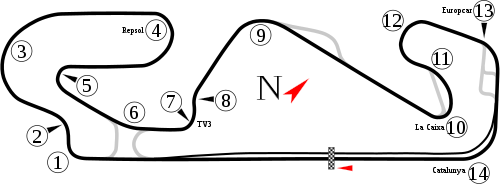
About the Circuit de Barcelona-Catalunya
Located 30 km north-east of Barcelona in the town of Montmeló, the Circuit de Barcelona-Catalunya has been Formula 1's most thoroughly studied circuit since joining the calendar in 1991. Every team uses the circuit for pre-season winter testing, meaning that by the time the Spanish Grand Prix arrives mid-season, engineers have logged thousands of laps of data and know exactly how their car performs here. This makes Barcelona one of the best indicators of true outright car performance — there are no circuit-specific quirks or unusual characteristics to hide behind.
The circuit is a comprehensive test of every aspect of an F1 car. The long main straight tests top speed and power unit efficiency. The high-speed right-handers of Turn 3 and the old Campsa corner test aerodynamic downforce and tyre compliance. The slow hairpins test traction and mechanical grip. The final chicane tests braking stability. Few circuits demand such an all-round package, which is precisely why teams find pre-season testing here so invaluable.
Spain has a deeply passionate F1 following, turbocharged by Fernando Alonso's two World Championship titles in 2005 and 2006. The Catalan crowds who pack the grandstands bring genuine expertise and enthusiasm, and with the Barcelona skyline visible from the circuit on a clear day and the Mediterranean sun overhead, race day has a vibrancy and warmth that makes it one of the most enjoyable events of the season for fans attending in person.
Key Corners
Barcelona tests every dimension of an F1 car across its 16 corners — from heavy-braking hairpins to flat-out sweepers that separate the aerodynamically gifted from the rest.
Turn 1 — Elf
The opening heavy-braking zone at the end of the main straight is the primary overtaking opportunity at race start. Cars arrive at around 320 km/h before braking hard for this tight right-hander. The wide entry allows for multiple lines, and aggressive moves at the first corner are common and expected in the opening laps.
Turn 3 — Renault
A fast right-hander taken at high speed that tests aerodynamic downforce and tyre lateral load. Taken correctly it flows seamlessly into the following corners, maintaining momentum through the first sector. Getting the apex and exit right sets up the entire middle portion of the lap.
Turn 10 — Campsa
The sweeping downhill right-hander known as Campsa is one of the most demanding corners on the circuit. Drivers carry significant speed over a crest before committing to the downhill arc, placing enormous load on the front tyres. A corner that is critical to tyre management over a long stint.
Turns 14–16 — Final Chicane
The final chicane sequence before the main straight is a vital braking zone and a late-race overtaking opportunity. Getting a clean exit here and maximising acceleration onto the pit straight is crucial for protecting or attacking positions, particularly with DRS available down the main straight.
Race Atmosphere
The Spanish Grand Prix draws one of the most knowledgeable motorsport crowds in Europe. Spain's F1 heritage stretches back to the early 1950s, and Fernando Alonso's success as a two-time world champion turned an already passionate fanbase into a truly mainstream national phenomenon. The grandstands fill with fans in Alonso's Number 14 colours, creating a striking visual backdrop even in years when he is not in contention for the win.
The proximity of Barcelona — one of Europe's most vibrant and culturally rich cities — means race weekend activities extend well beyond the circuit. The city's beaches, architecture, and nightlife draw fans from across the world, and the combination of Mediterranean climate, quality racing, and access to one of the world's great cities makes the Spanish GP one of the most enjoyable events on the entire calendar to attend.
Tyre Strategy
Barcelona is a Hard/Medium compound race with consistently high tyre degradation, particularly in the summer heat. The combination of high-speed sustained loading in Turns 3 and 9, hard braking zones, and a long lap means every compound wears at a meaningful rate.
A two-stop strategy is often the fastest theoretical approach, but track position at Barcelona makes overtaking difficult enough that many teams opt for a one-stop strategy to preserve position, carefully managing rear tyre degradation through the second half of the stint. Teams know this circuit so well from testing that their strategy simulations are exceptionally accurate.
How to Watch the Spanish Grand Prix in the UK
The Spanish Grand Prix is broadcast live on Sky Sports F1 in the UK, covering all sessions across the full race weekend. Spain is on CEST (UTC+2) in summer, one hour ahead of UK BST, meaning the race typically starts at 3pm local time / 2pm UK time — a comfortable Sunday afternoon slot for British viewers.
Channel 4 broadcasts free-to-air highlights after the race. Live coverage requires a Sky Sports subscription or a NOW TV Sports Pass, with streaming available via Sky Go. Visit our TV schedule page for full session times and broadcast details.
Previous Spanish GP Winners
| Year | Winner | Team |
|---|---|---|
| 2025 | Lando Norris | McLaren |
| 2024 | Max Verstappen | Red Bull Racing |
| 2023 | Max Verstappen | Red Bull Racing |
| 2022 | Max Verstappen | Red Bull Racing |
| 2021 | Lewis Hamilton | Mercedes |